As a company grows, marketing usually becomes more complicated. What worked when the founder was handling marketing personally may no longer be enough once there are multiple channels, a larger team, more competition, and bigger revenue targets.
This is where a fractional CMO can help. A fractional CMO provides senior marketing leadership without requiring a company to hire an in-house CMO. Rather than focusing on one channel or completing marketing tasks, they look at the marketing function as a whole.
So in this article, let’s explore what a fractional CMO does, their core responsibilities, benefits that companies can gain, and what to look for when hiring your own fractional CMO.
What Is a fractional CMO?
A fractional CMO is an experienced marketing executive who works with a company on a part-time, flexible, or defined-term basis rather than as a full-time employee. Their core role is to develop strategic marketing initiatives, working alongside leadership and founders without being a full-time hire.
In practical terms, a company gets access to senior marketing thinking without necessarily needing a full-time executive. The exact arrangement varies. Some fractional CMOs work a few days each month, while others become much more deeply embedded in a business. The scope is usually determined by what the company actually needs rather than by an arbitrary number of hours.
What does a fractional CMO do?
A fractional CMO's responsibilities can cover the entire marketing function. The exact scope depends on the company's stage, goals, team, budget, and existing marketing capabilities.
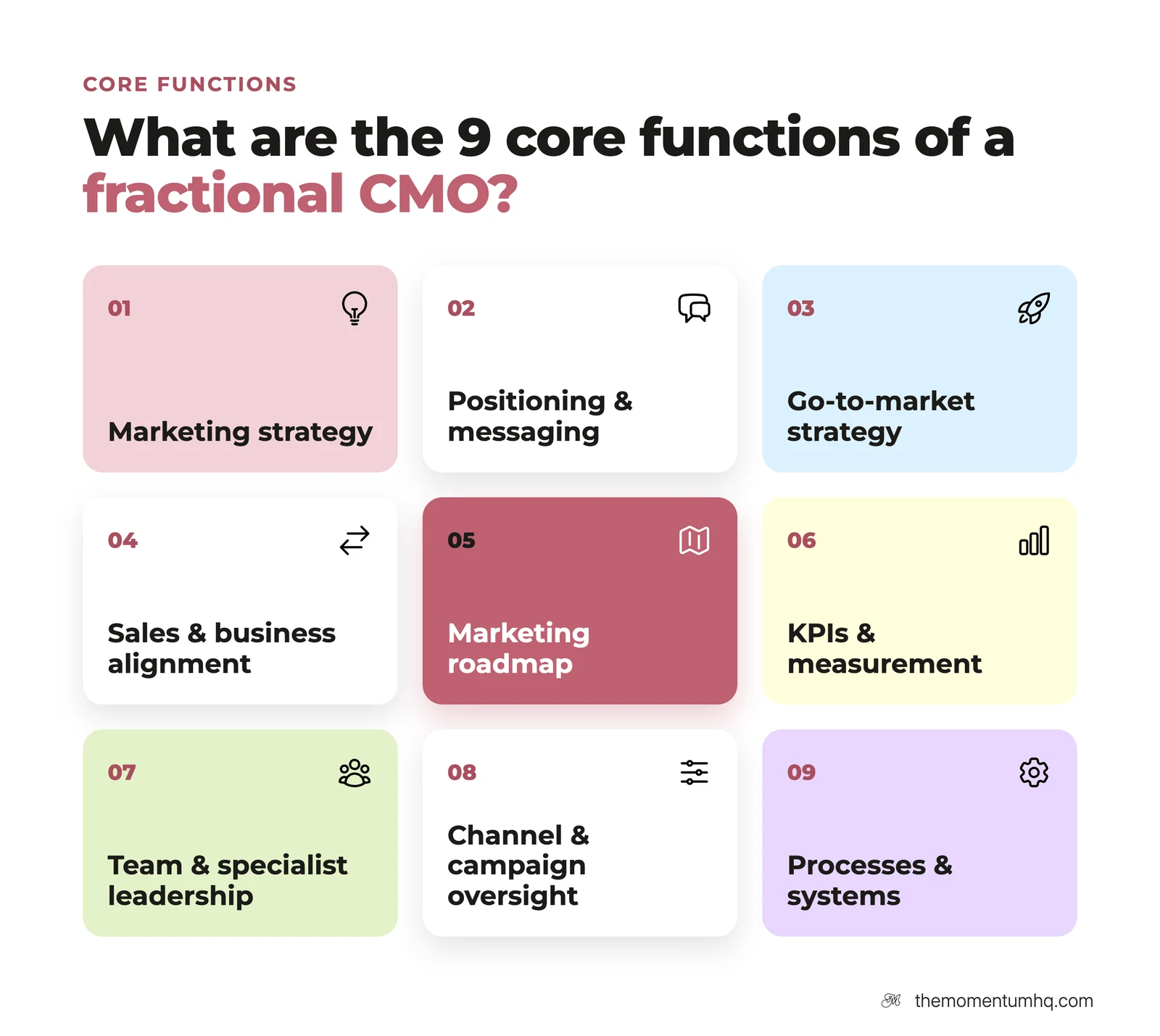
Here are the 9 core functions of a fractional CMO:
1. Develop the marketing strategy
A fractional CMO starts by understanding the business before deciding what marketing should do. That means looking at the company's
- Goals
- Customers
- Competitive position
- Existing marketing activity
- Sales process
- Available resources and budget
- Performance data to date
Once they have a clear snapshot of where the company is, the fractional CMO can help develop a marketing strategy that establishes priorities and determines where the company should focus its time and budget.
The marketing strategy should provide a practical framework for deciding what the company should do, what it should stop doing, and what needs to happen next.
2. Define positioning and messaging
Good marketing becomes much harder when a company isn't clear about what it stands for, who it serves, or why buyers should care.
A fractional CMO can help clarify:
- Who the company is targeting
- What problem it solves
- How it is different
- How the offer should be positioned
- What messages should be consistent across channels
- How the company's expertise should be communicated
This positioning then informs everything from the website and sales materials to content, campaigns, thought leadership, and social media.
3. Build the go-to-market strategy
When a company is launching a product, entering a new market, targeting a new audience, or changing its offer, marketing needs more than a list of promotional activities; it needs a plan that ties every decision back to revenue.
A fractional CMO can help determine:
- Who the target audience is
- What the value proposition should be
- Which channels make sense
- How prospects should move from awareness to consideration and conversion
- What content and campaigns are required
- How marketing and sales should work together
- What success should be measured against
For example, consider a B2B software company preparing to launch a new product tier aimed at mid-sized enterprises, a segment they've never sold into before. Rather than just briefing the team to "run some LinkedIn ads and send an email campaign," a fractional CMO would define:
- Who the actual buyer is in that segment
- What pain point makes this tier worth paying for
- Which channels that buyer actually pays attention to
From there, they'd map out the journey and set clear checkpoints (like qualified leads or pipeline generated) so the team knows if the launch is working within the first 90 days. The objective is to connect the go-to-market plan to the commercial reality of the business, not just to generate activity, but to generate revenue.
4. Align marketing with business and sales goals
When people Google "what does a fractional CMO do," they're often trying to understand how this role fits in with the rest of the business. A fractional CMO's job is to make sure marketing is working toward the same goals as sales, product, and leadership, instead of operating as an island.
To do this, a fractional CMO works closely with founders, sales, product, and even the development team to understand what the business actually needs from marketing at that specific stage.
For example, if a B2B SaaS company gets site traffic but poor-fit leads, more traffic isn't the solution. A fractional CMO redirects focus toward qualified pipeline: refining the target profile, updating messaging, and aligning with sales on lead qualification. If win rates are low due to weak differentiation, they prioritize positioning before spending on acquisition.
This is where senior marketing leadership matters. A fractional CMO translates business objectives like these into marketing priorities, and sets metrics that leadership can actually tie back to revenue.
5. Build the marketing roadmap
Marketing teams often have more ideas than they have resources to execute them. A fractional CMO helps turn those ideas into priorities. One of the main things a fractional CMO does for B2B companies is develop a marketing roadmap. This roadmap is a visual that can help establish:
- What needs to happen first
- What can wait
- Who owns each activity
- What resources are required
- How success will be measured
- When the strategy should be reviewed
This prevents the company from constantly jumping between new channels, campaigns, and tactics without building momentum.
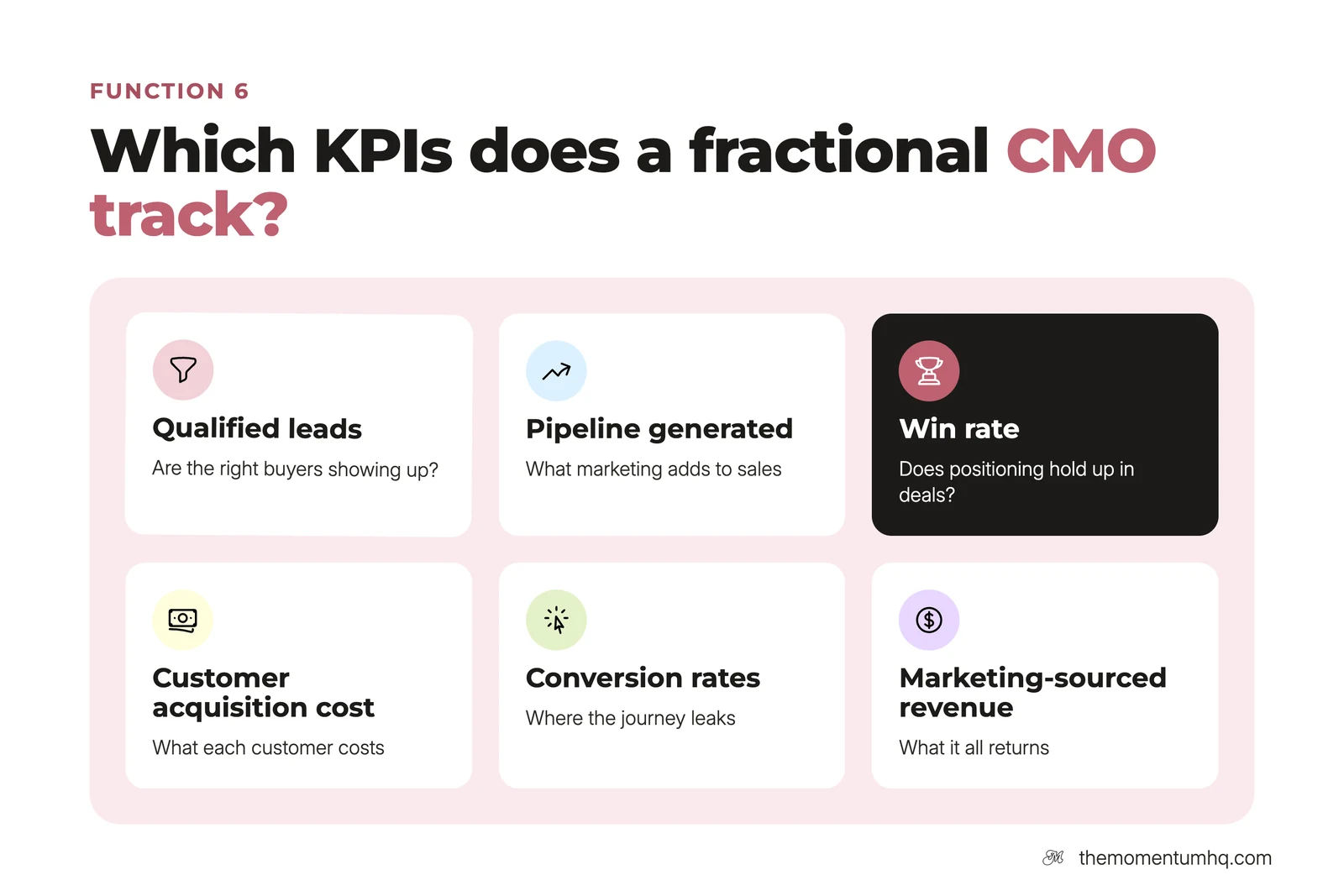
6. Set marketing KPIs and measure performance
A fractional CMO can establish the measurement framework used to understand whether marketing is working. Depending on the business, this includes KPI such as:
7. Lead internal teams and external specialists
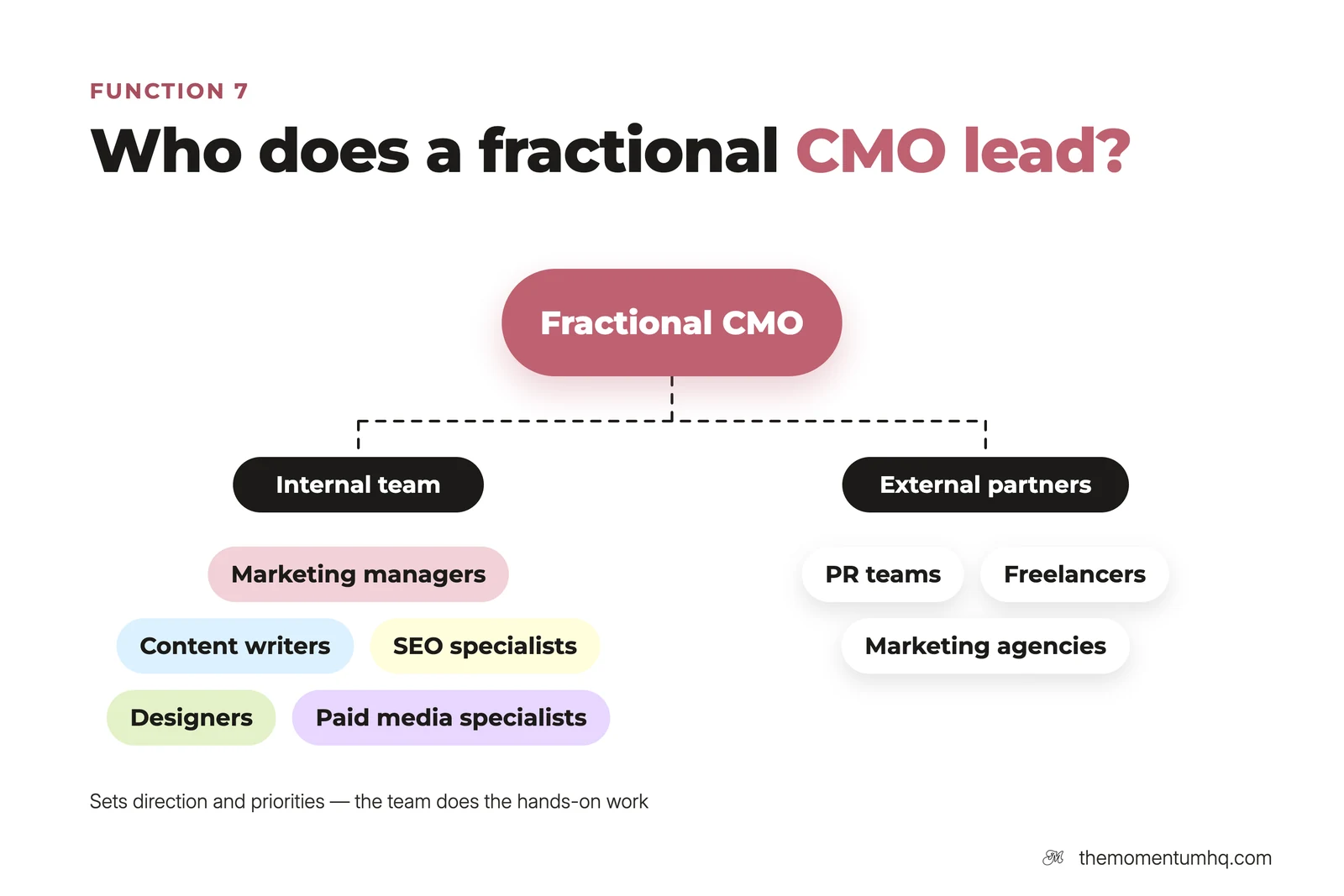
One thing to keep in mind is that a fractional CMO is a strategic leader, but not necessarily an executor. For a fractional CMO to accomplish their job, they need to lead an internal or outsourced team of marketing specialists.
Therefore, a core function of a fractional CMO is to hire, manage, lead, and delegate to this marketing team.
That might include:
- Marketing managers
- Content writers
- SEO specialists
- Designers
- Paid media specialists
- PR teams
- Freelancers
- Marketing agencies
The fractional CMO provides direction, establishes priorities, reviews performance, and makes sure the different parts of marketing are working toward the same objectives.
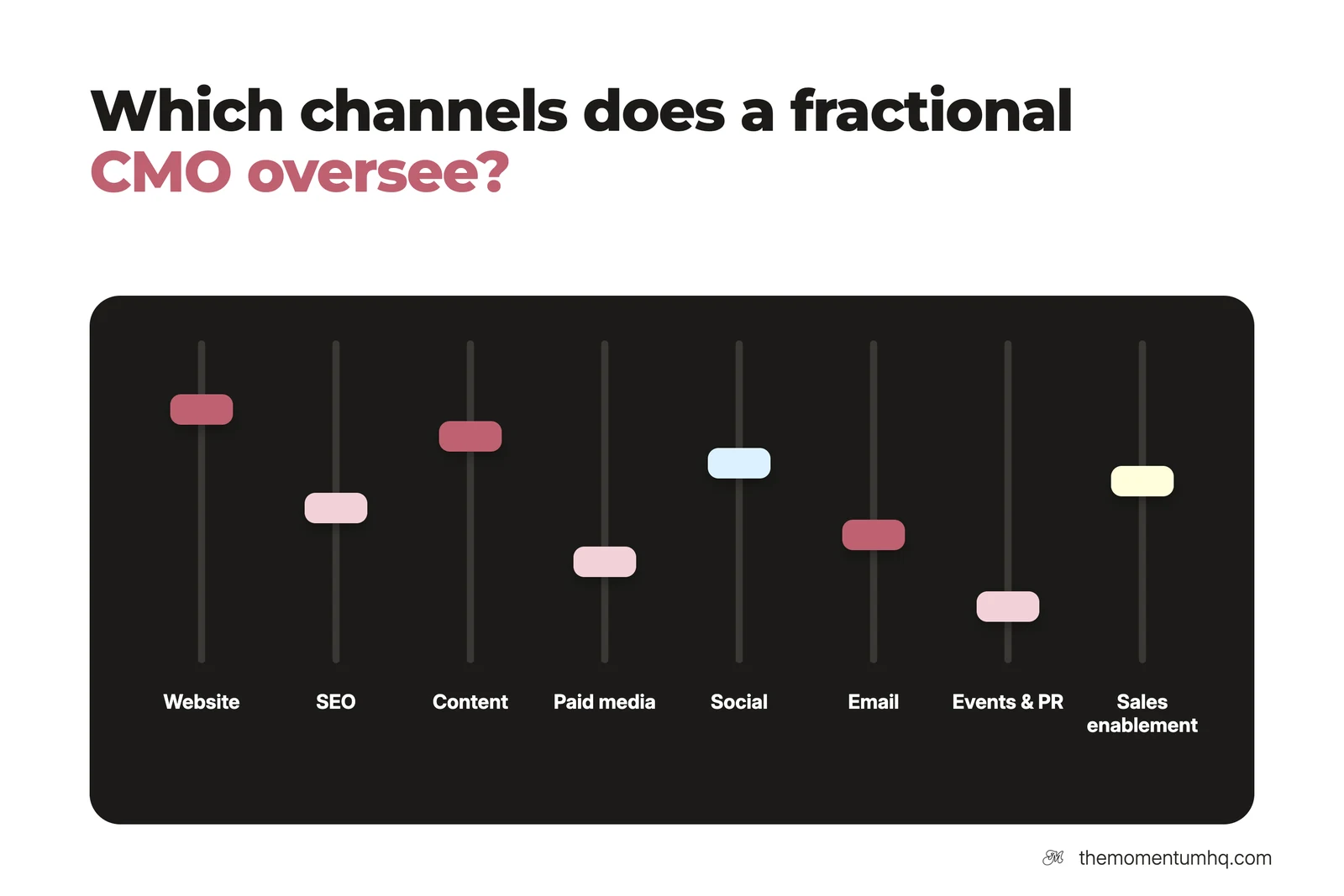
8. Oversee marketing channels and campaigns
A fractional CMO doesn't just set strategy from a distance; they also keep an eye on the day-to-day channels and campaigns that carry that strategy out, making sure each one is actually pulling its weight. Depending on the company, this can include oversight of internal teams and external partners.
The fractional CMO doesn't need to be the technical specialist in every one of these areas. Their job is to understand how the pieces fit together and make sure resources are being used appropriately.
9. Improve marketing processes and systems
Marketing becomes difficult to scale when everything depends on individual people remembering what needs to happen. Therefore, a fractional CMO steps in to improve marketing processes in terms of time management, efficiency, and accuracy.
They can help build repeatable systems across:
- Planning
- Briefing
- Content production
- Campaign management
- Reporting
- Approvals
- Team communication
- Performance reviews
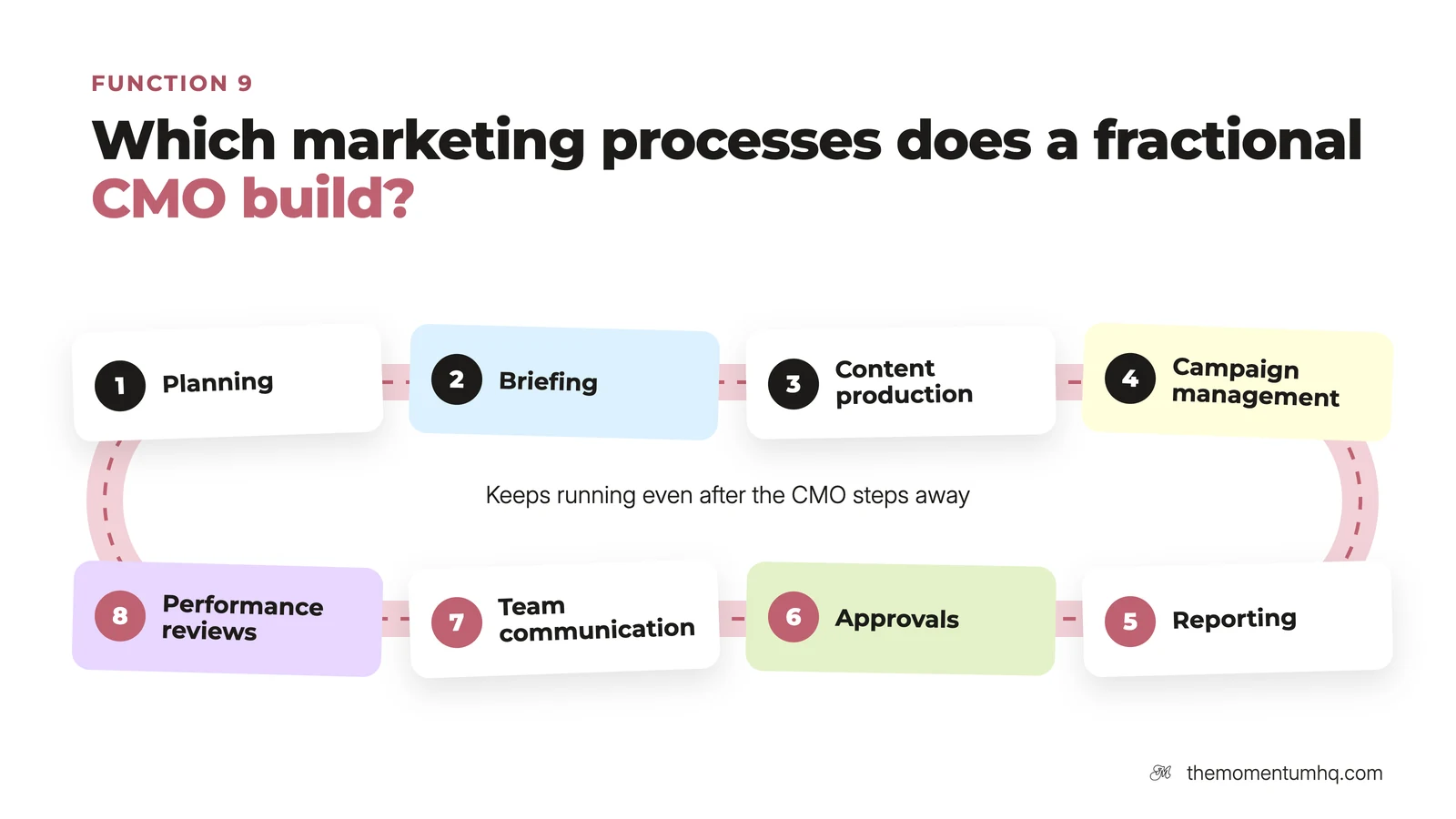
This creates a marketing function that can continue operating as the company grows. Even if the fractional CMO departs at a later time, these processes can keep the company running without reliance on a single individual.
What Does a Fractional CMO Actually Own?
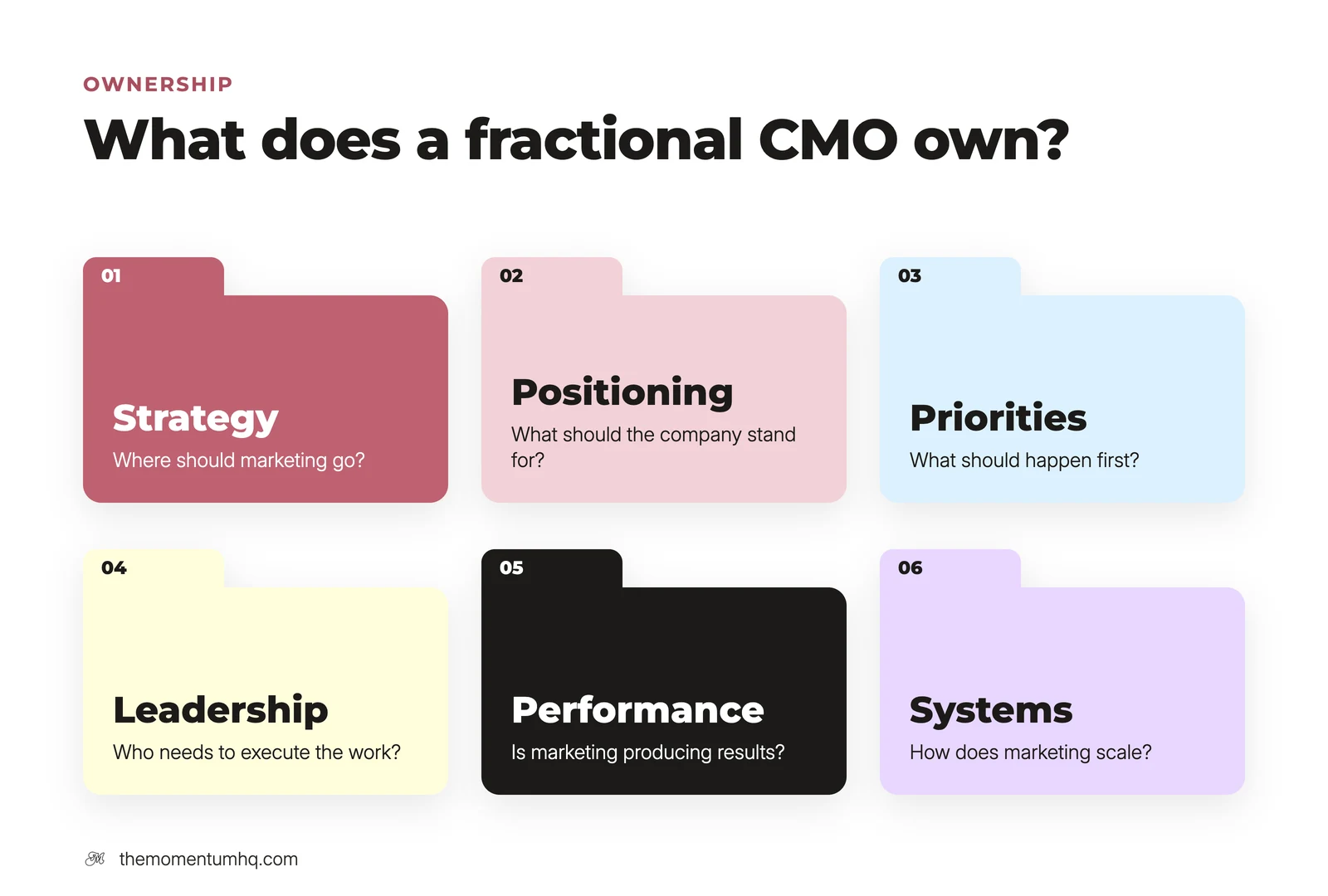
- Strategy: Where should marketing go?
- Positioning: What should the company stand for?
- Priorities: What should happen first?
- Leadership: Who needs to execute the work?
- Performance: Is marketing producing meaningful results?
- Systems: How does marketing become repeatable and scalable?
What does a fractional CMO do day to day?
A fractional CMO develops strategy, oversees a marketing team, and reviews marketing performance day to day, depending on where they are in their engagement with the company.
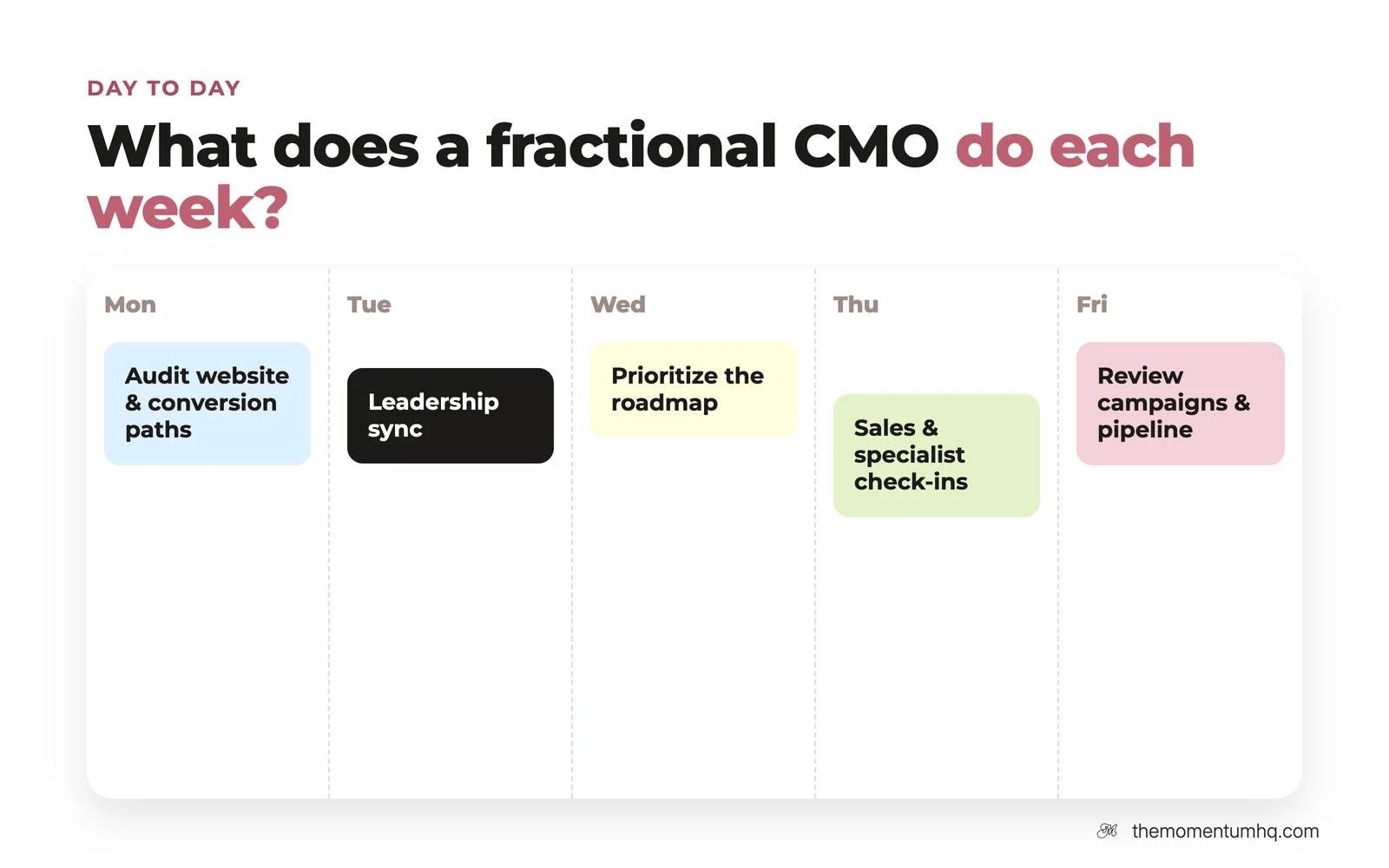
The first step is often understanding what already exists. A fractional CMO may review:
- Website and conversion paths: The fractional CMO can analyze and assess your website’s performance, user experience, and key conversion journeys. This helps identify what is working, what isn't, and where the biggest gaps are.
- Prioritize marketing activities: Once the situation is clear, the fractional CMO determines what deserves attention first. Not every problem needs to be solved simultaneously. A good roadmap might prioritize fixing positioning before increasing content production, or improving conversion before increasing traffic.
- Review campaigns and performance: Fractional CMOs can regularly review campaign results, content performance, pipeline data, and other marketing metrics. The purpose isn't to create reports. It is to use performance information to make better decisions about what happens next.
- Work with founders and leadership: Because the role operates at a senior level, regular communication with company leadership is important. The fractional CMO should understand the company's commercial priorities and give leadership a clear view of what marketing is doing, what it needs, and where adjustments are required.
- Collaborate with sales and other specialists: Marketing rarely succeeds in isolation. A fractional CMO may work with sales to improve lead quality, with product teams on positioning, or with writers and agencies to translate strategy into execution.
What is the difference between a fractional CMO and other marketing roles?
Having a fractional CMO doesn't mean your existing marketing roles stop. In many cases, the opposite is true: the fractional CMO makes those roles more effective by giving them clearer priorities and direction.
Here’s how a fractional CMO is different than other marketing roles:
| Role | Primary focus | Typical responsibility |
|---|---|---|
| Fractional CMO | Strategy and marketing leadership | Sets direction, establishes priorities, aligns marketing with business goals, leads teams, and oversees performance |
| Full-time CMO | Strategy and executive leadership | Owns the marketing function as a permanent executive |
| Marketing Consultant | Specialist advice | Provides expertise or recommendations around a defined problem |
| Marketing Agency | Execution and specialist services | Delivers agreed services such as content, SEO, paid media, design or campaigns |
| Marketing Manager / Head of Marketing | Marketing management and execution | Manages day-to-day marketing activity and internal execution |
The boundaries can overlap. A fractional CMO may advise, manage, and sometimes get involved in execution. An agency may provide strategy as well as execution. The difference is usually the level of ownership, seniority, integration, and scope.
What does a fractional CMO need from a company to succeed?
A fractional CMO can bring experience and strategic direction, but they cannot operate effectively without access to the business. Here’s what they will typically need from founders and companies they are working with:
- Clear business goals: A defined understanding of the company's commercial objectives, whether that's increasing qualified pipeline, entering a new market, improving conversion rates, launching a product, strengthening positioning, or building a repeatable customer acquisition system.
- Access to marketing and sales data: Visibility into customer research, CRM records, sales pipeline, campaign performance, website analytics, conversion rates, and existing marketing reports to identify opportunities and make informed decisions.
- An appropriate marketing budget: A realistic budget for executing the strategy, including advertising spend, marketing tools, content production, agency or freelancer support, and other resources required to achieve the company's priorities.
- Internal execution resources: Access to an internal marketing team, freelancers, agencies, or specialist partners who can implement campaigns, produce content, manage channels, and execute the initiatives outlined in the marketing strategy.
- Alignment between marketing and sales: Agreement on target audiences, ideal customer profiles, lead qualification criteria, pipeline targets, and revenue objectives, along with a process for sharing feedback and evaluating lead quality.
- Decision-making authority: Sufficient authority to establish marketing priorities, allocate approved resources, coordinate teams, recommend strategic changes, and move initiatives forward without unnecessary approval delays.
Ultimately, a fractional CMO can only be as effective as the environment the company provides. Clear goals, access to the right information, a realistic budget, and people who can execute the strategy allow them to turn marketing priorities into measurable business outcomes.
The more closely the company's leadership, marketing team, and sales function work together, the easier it becomes to identify what is working, address gaps, and build a marketing operation that supports long-term growth.
When should you hire a fractional CMO?
There isn't one specific company size or revenue number that automatically means it's time to hire a fractional CMO. However, we can often see these typical scenarios across companies that do end up requiring a fractional CMO’s services:
Your company has outgrown founder-led marketing
Founder-led marketing can work extremely well in the early stages, nobody understands the product or the customer better than you do. But at some point, that strength starts working against you.
You're the one deciding what to publish, which channels to try next, how to position the product against competitors, and whether any of it is actually producing results often late at night, after everything else on your plate.
If marketing decisions are still landing on your desk and you're not sure they should be, that's usually the first sign. A fractional CMO can take responsibility for the marketing function while keeping you involved exactly where your voice and instincts matter most, not everywhere.
Your marketing has become more complex
As companies grow, marketing rarely stays simple. You add a channel here, a campaign there, maybe a specialist or an agency for paid ads and at some point you realize no one person actually sees how it all fits together.
Each piece might be working fine on its own, but nobody can tell you if they're working together. A fractional CMO steps in to bring these moving parts into one coherent strategy, rather than letting every channel run its own race.
You have a marketing team but lack senior leadership
This one is common, and it's not a reflection of your team's ability. You may already have capable marketers who are good at their jobs, but good execution without senior direction can only take you so far.
If your team is waiting on you for decisions you're not equipped to make, or priorities keep shifting because no one’s setting them, a fractional CMO can become that strategic layer.
Your marketing activity is growing but results are unclear
More content, more campaigns, more spend, and yet, when someone asks what it's actually producing, there's no confident answer. This is one of the more frustrating places to be, because it doesn't look like a problem from the outside. Activity is up. But if you can't draw a straight line from what marketing is doing to what the business is getting in return, that disconnect needs senior oversight to diagnose not more activity.
You need senior marketing leadership without a full-time hire
This is the situation most companies are actually in. You need the judgment, experience, and accountability of a senior marketing leader, but not necessarily five days a week of it, and not at the cost of a full-time executive salary and benefits. Forbes has pointed to this exact gap as a key reason companies are increasingly turning to fractional CMOs bringing in experienced leadership without the overhead, or the risk, of a permanent hire that may not be the right fit yet.
How much does a fractional CMO cost?
There is no single standard price for a fractional CMO. However, fractional CMO engagements in 2026 cost between $5,000 and $15,000 per month on a retainer basis.
This price can go higher or lower, depending on the following factors:
- Scope of responsibility
- Time commitment
- Experience
- Company complexity
- Industry
- Nature of the engagement
Engagements can be structured as monthly retainers, defined projects, or other arrangements depending on the industry norms and your business’s requirements.
Who is a fractional CMO best suited for?
A fractional CMO can work across different industries and company sizes. The common factor isn’t the industry itself, but the company's need for senior marketing leadership. Here are some of the common profiles that benefit the most with a fractional CMO engagement:
Growth-stage companies
Growth-stage companies often reach a point where marketing needs to become more structured. A fractional CMO can help turn disconnected activities into a coherent strategy, establish priorities, build measurement systems, and create the processes needed to scale.
Founder-led businesses
When founders are still heavily involved in marketing, a fractional CMO can take ownership of the marketing function without taking away the founder's voice.
The founder can remain involved in thought leadership, customer insight, and major strategic decisions while the CMO manages the broader marketing system.
SaaS and technology companies
SaaS and technology companies often have complex products, long buying cycles, multiple stakeholders, and technical audiences.
A fractional CMO can help simplify the positioning, define the target audience, develop demand-generation priorities, and connect content and marketing activity to the sales process.
Companies with lean marketing teams
A small team doesn't necessarily need more people before it needs better direction. A fractional CMO can provide the senior layer that helps a lean team determine what to prioritize, what to outsource, and where specialist support is actually needed.
Companies using freelancers or agencies
Freelancers and agencies can be excellent execution resources, but multiple specialists can create fragmented marketing when nobody owns the overall strategy. A fractional CMO can sit above those relationships, establish priorities, coordinate specialists, and make sure execution remains connected to the company's goals.
How do you choose the right fractional CMO?
The right fractional CMO isn't necessarily the person with the longest list of services. Look for someone who understands the company's stage, commercial goals, customers, and constraints.
You should consider:
- Relevant experience: Have they worked with businesses facing similar growth or marketing challenges?
- Strategic thinking: Can they explain not only what the company should do, but why?
- Commercial understanding: Do they connect marketing decisions to customers, pipeline, revenue, and business goals?
- Execution awareness: Can they turn strategy into practical priorities rather than leaving the company with a strategy document?
- Leadership: Can they work effectively with founders, internal marketers, sales teams, agencies, and specialists?
- Measurement: Can they establish meaningful KPIs and explain what the data actually means?
- Scope: Is it clear what they own, what the internal team owns, and what external partners own?
A useful engagement should make those expectations clear before the work begins. Forbes recommends setting measurable objectives, agreeing on a North Star, integrating the fractional CMO into the business, and ensuring access to the information they need.
FAQs
How many hours does a fractional CMO work?
A fractional CMO typically works between 10-20 hours a week across various industries. However, depending on the scope, company budget, and team size, these hours can vary.
Can a startup afford a fractional CMO?
Yes, a startup can afford a fractional CMO if it has acquired capital through personal or funding channels. One of the reasons companies consider a fractional CMO is that they can access senior marketing expertise without committing to a full-time executive hire.
Does a CMO report to a CEO?
Typically, a CMO operates as part of the company's senior leadership structure and works closely with the CEO or founder. A fractional CMO can have a similar relationship, although the exact reporting and decision-making structure depends on the company and engagement.
Does a fractional CMO replace a marketing agency?
Not necessarily. A fractional CMO and an agency can work together. The fractional CMO can establish the strategy, priorities, KPIs, and direction while an agency or specialist handles specific execution.
For a company that already has several agencies or freelancers, the fractional CMO can actually make those relationships more effective by providing a single strategic layer above them.
How long should you work with a fractional CMO?
There is no fixed duration. Some companies use fractional CMOs for a defined project or transition period. Others maintain the relationship for longer because they need ongoing senior marketing leadership. The right duration depends on what the company is trying to accomplish.
Final Thoughts
A fractional CMO brings the strategic direction, marketing leadership, and operational structure businesses need to turn marketing into a driver of sustainable growth. For companies that need experienced marketing leadership without the cost of a full-time executive, a fractional CMO offers a flexible way to build a more focused, accountable, and scalable marketing function.
At Momentum, we help businesses turn marketing into a structured growth engine through strategic marketing leadership and performance-focused execution. Our fractional CMO services are designed to help businesses clarify their direction, prioritize the right opportunities, and build systems that support long-term growth.
Whether you're establishing your marketing function or looking to bring greater direction to an existing team, Momentum provides the strategic expertise and hands-on support to move your business forward. Reach out to us today and let’s have a conversation.