Marketing becomes more complicated as a business grows. What starts with a founder handling a few social posts or a freelancer writing occasional content can eventually turn into a need for strategy, content, search, paid campaigns, email, reporting, and someone to connect all of it to the wider business goals. At that point, many companies start considering whether they need outside marketing support.
That is where the question “What is a marketing agency?” comes in. A marketing agency can take on different roles depending on the business and its needs, from providing expertise in a specific area to managing a company’s broader marketing function. But not every agency works the same way, and not every growing company needs one.
This guide looks at what marketing agencies do, the types of agencies available, how they typically work, and why companies choose to hire them. More importantly, it will help you determine whether an agency is the right fit for your business or whether another approach would make more sense.
What Is a Marketing Agency?
A marketing agency is an external company that provides marketing services to businesses. Depending on its expertise and the scope of the engagement, an agency may help with a specific part of a company’s marketing or take responsibility for the broader marketing function.
Some agencies specialize in one area, such as SEO, paid advertising, branding, or social media. Others provide a wider range of services, bringing strategy, content, search, advertising, and other marketing activities together under one team.
The level of involvement can also vary. An agency may be brought in to execute an existing plan, develop the strategy itself, or do both.
For growth-stage businesses, the distinction between strategy and execution is particularly important. Marketing support is more valuable when someone is looking at the business as a whole rather than simply completing individual marketing tasks.
In some cases, an agency can effectively operate as an outsourced marketing department, providing the strategic direction and specialist capacity that a company is not yet ready to build entirely in-house.
What Does a Marketing Agency Do?
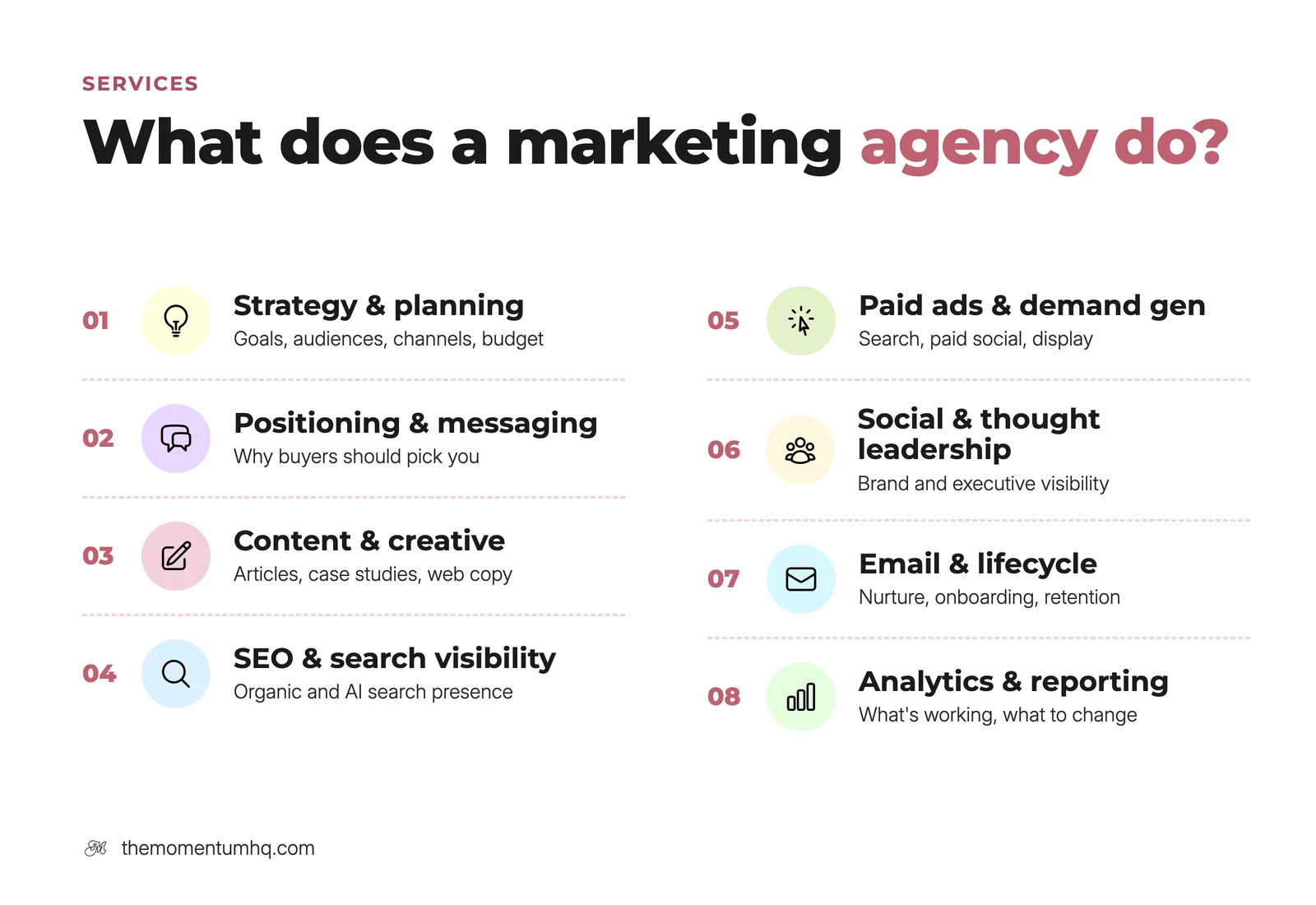
A marketing agency can take on anything from a single marketing function to a broader role across the business. The exact work depends on the agency’s specialization and the scope of the engagement, but most services fall into a few core areas:
Marketing strategy and planning
Marketing strategy defines what the business is trying to achieve through marketing and how it plans to get there. This can include audience research, competitive analysis, channel selection, campaign planning, budgets, and marketing priorities.
For a growth-stage company, strategy also helps determine what not to do. Instead of spreading resources across every available channel, the agency can identify where the business is most likely to reach the right audience and focus its efforts there.
Positioning and messaging
Positioning determines how a company is understood in its market and why a buyer should consider it over other options. Messaging turns that positioning into language the business can use across its website, sales materials, content, advertising, and other channels.
This becomes especially important when a company has grown beyond its original audience or its offering has become more complex. Clear positioning gives the rest of the marketing function a consistent direction.
Content and creative
Agencies may create and manage a range of marketing content, including:
- Blog articles
- Case studies
- Website copy
- Email campaigns
- Social posts
- Thought leadership
- Landing pages
- Graphics
- Other creative assets
The scope varies by agency. Some focus primarily on content production, while others develop the content strategy as well as the individual pieces. The goal should be to create content that has a defined purpose, whether that is building awareness, educating buyers, supporting sales, or generating demand.
SEO and search visibility
Search engine optimization (SEO) involves improving a company's visibility in unpaid search results. Agency work can include:
- Keyword research
- Technical SEO
- On-page optimization
- Content development
- Internal linking
- Authority building
Search behavior is also changing as people increasingly encounter information through AI-generated answers as well as traditional search results. Agencies working in this area may therefore consider both conventional SEO and how a brand is represented across newer search experiences.
Paid advertising and demand generation
Paid marketing uses advertising platforms to reach specific audiences and generate actions such as website visits, leads, or purchases. Depending on the business, this can include search advertising, paid social, display advertising, and other channels.
Demand generation is broader than simply running ads. It can involve creating awareness and interest among potential buyers before they are ready to make a purchase. For B2B companies in particular, this often requires coordination between paid campaigns, content, thought leadership, website experiences, and sales.
Social media and thought leadership
Social media can help companies:
- Build visibility
- Communicate with their audience
- Distribute content
- Develop relationships with potential customers
An agency may manage the company's social presence, develop content, handle publishing, or support community engagement.
For B2B companies, social media can also support executive visibility and thought leadership. This often means turning a founder or executive's expertise into useful content rather than treating social media as a publishing schedule.
Email and lifecycle marketing
Email marketing covers more than newsletters. Agencies may help businesses develop lead nurturing campaigns, customer communications, promotional emails, onboarding sequences, and other automated or recurring communications.
The right approach depends on where someone is in their relationship with the business. A prospective buyer may need educational content, while an existing customer may need onboarding, product information, or retention communications.
Analytics, reporting, and optimization
Marketing agencies may track and analyze metrics across the channels they manage. This can include website traffic, conversions, leads, advertising performance, search visibility, engagement, and other indicators relevant to the company's objectives.
Reporting should help answer what is working, what is not, and what should change next. A list of metrics on its own is not particularly useful if it does not inform a marketing decision.
For companies using an agency across several areas, this analysis also provides a way to connect individual activities to broader marketing priorities, rather than evaluating the channel in isolation.
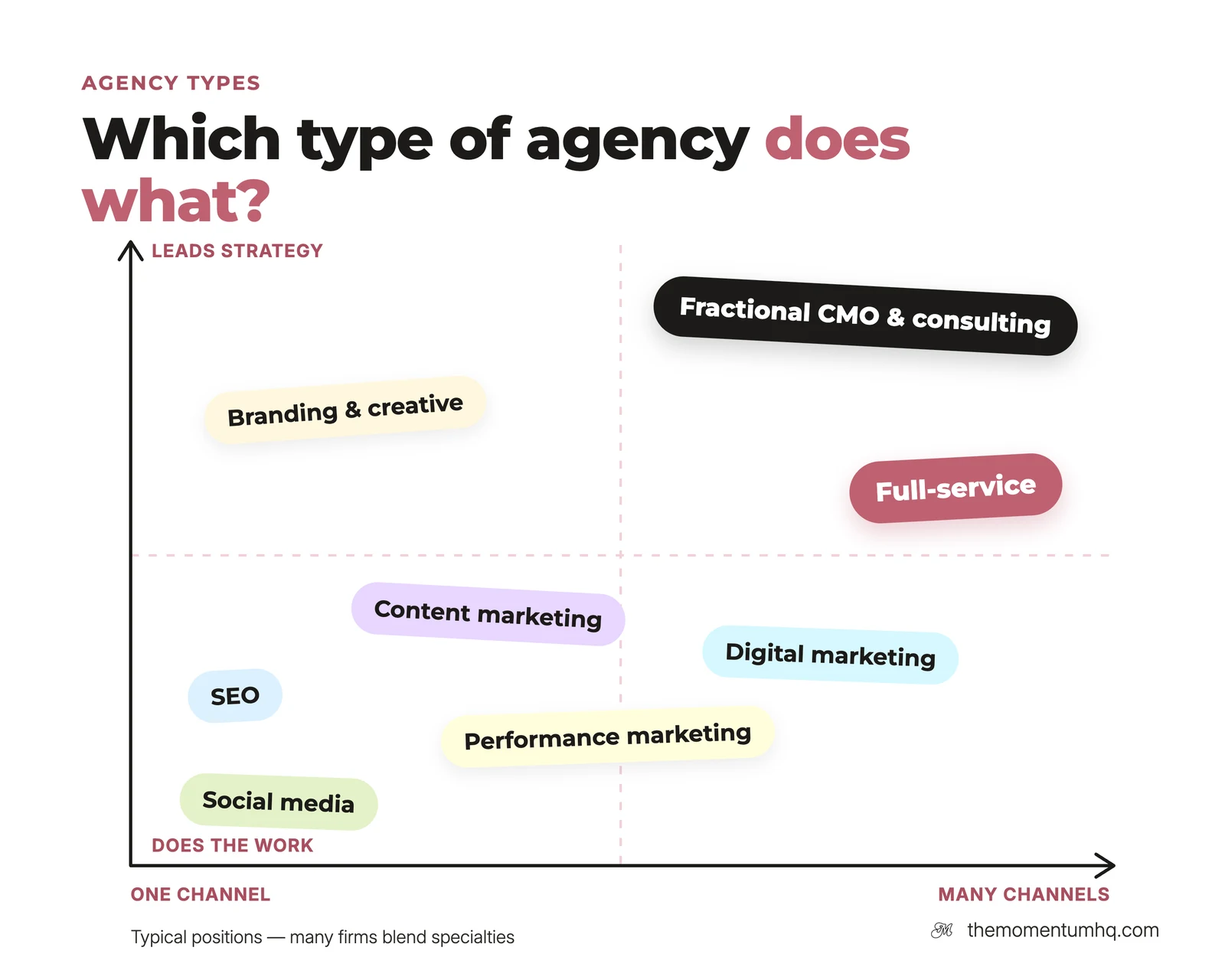
What Types of Marketing Agencies Are There?
Marketing agencies vary by the services they provide, the channels they specialize in, and how closely they work with a client's internal team. Some focus on one discipline, while others combine several capabilities under a broader marketing strategy.
The right type of agency depends on what your business needs. Common types include:
- Full-service marketing agencies: Provide a broad range of marketing services, which may include strategy, content, SEO, paid advertising, social media, email, creative, and analytics. They are typically suited to businesses that want one external partner to manage multiple areas of marketing.
- Digital marketing agencies: Focus primarily on online channels such as SEO, paid search, paid social, content, email, social media, and website optimization. Their scope can range from managing individual channels to coordinating a broader digital marketing program.
- SEO agencies: Specialize in improving a company's visibility in organic search through activities such as technical SEO, keyword research, content optimization, internal linking, and authority building. They are a fit for businesses where search visibility is a significant acquisition or awareness channel.
- Content marketing agencies: Develop and produce content designed to support specific marketing objectives, including articles, case studies, guides, email content, and thought leadership. They may handle both the content strategy and the ongoing production.
- Social media agencies: Manage a company's presence across social platforms through strategy, content creation, publishing, community management, and, in some cases, paid social advertising. The work can range from maintaining an active presence to building social into a broader demand or thought leadership strategy.
- Performance marketing agencies: Focus on measurable customer acquisition and conversion, typically through paid advertising, landing pages, conversion optimization, and campaign testing. They are generally more focused on direct response than broader brand or positioning work.
- Branding and creative agencies: Help businesses define and express their brand through positioning, messaging, visual identity, creative direction, and campaign development. They are often brought in for launches, repositioning, rebrands, or major changes in how a company presents itself.
- Fractional CMO and marketing consulting firms: Provide senior marketing expertise without requiring a full-time executive hire. A consultant may advise on a specific marketing challenge, while a fractional CMO typically takes a more active role in setting priorities, guiding strategy, and leading the marketing function.
The boundaries between these agency types are not always clear, and many firms combine multiple specialties. Rather than choosing an agency based on its label, start by identifying the marketing capabilities your business is missing and the level of support you need.
How Does a Marketing Agency Work?
The way an agency works depends on its services, but a strong engagement usually follows a clear process. Oftentimes, it looks like this:
Assess the business and marketing goals
The agency first looks at the business, its audience, competitive environment, existing marketing activity, and commercial goals. This might involve reviewing the website, existing content, analytics, customer research, sales feedback, and current campaigns.
For example, if a fintech company is getting website traffic but very few qualified inquiries, the problem may not be a lack of traffic. The agency might find that the positioning is unclear, the website does not speak to the right buyer, or there is no clear path from initial interest to conversion.
Build the strategy
The agency turns its findings into a marketing strategy that defines what the business should focus on and why. This can include positioning, messaging, target audiences, channel priorities, content themes, campaigns, and measures of success.
For example, a B2B consultancy trying to build credibility with senior decision-makers might prioritize LinkedIn thought leadership, expert-led articles, case studies, and email nurturing instead of investing heavily in consumer-focused social platforms.
Prioritize channels and initiatives
Once the strategy is clear, the agency determines where time and budget should go. The goal is not to be active on every channel, but to focus resources where they have a reasonable connection to the business's goals and audience.
For example, a SaaS company selling to enterprise buyers may find LinkedIn, search, email, and industry content more relevant than trying to build a presence across every social platform. A consumer beauty brand may make a very different choice.
Execute the marketing plan
The agency then puts the strategy into practice. Depending on the engagement, this might include writing content, managing LinkedIn, launching paid campaigns, optimizing website pages, building email sequences, or coordinating creative work.
For example, if the strategy identifies organic search as a priority, execution could include researching relevant topics, producing expert-led articles, improving existing pages, and building authority around important areas of the business.
Measure performance
The agency tracks the metrics that are relevant to the work and the company's objectives. The specific measures will differ by channel and business; for example, qualified leads and pipeline may matter more to a B2B company, while purchases and customer acquisition cost may be more relevant to an e-commerce business.
This also helps distinguish useful signals from vanity metrics. An increase in social followers may look positive, for example, but it matters less if the business is trying to reach a specific group of potential buyers and those buyers are not engaging or converting.
Optimize based on results
Marketing plans should change when the evidence shows that something is not working or that an opportunity has emerged. An agency may adjust messaging, change content priorities, reallocate advertising budget, test different landing pages, or stop an activity that is not contributing enough value.
For example, if a campaign is generating plenty of clicks but few qualified leads, the next step may be to investigate the offer, audience targeting, landing page, or conversion process rather than simply increasing the advertising budget. The point of measurement is to make better marketing decisions, not just to produce another report.
Why Do Companies Hire Marketing Agencies?
Companies usually hire marketing agencies when they need more marketing capability than their internal team can provide efficiently. The reason matters because an agency should solve a specific business need rather than simply add more activity. Common reasons include:
Access to specialized expertise
Marketing covers a wide range of disciplines, and it is difficult for one person to be highly experienced in all of them. An agency can give a business access to specialists in areas such as SEO, paid advertising, content, social media, analytics, or positioning without requiring separate hires for each function.
Senior marketing thinking
Some businesses have people executing marketing but lack someone experienced enough to set priorities and connect the work to broader business goals. An agency can provide senior-level strategic input without requiring the company to hire a full-time marketing executive.
For example, a company may already have a content writer and paid media specialist but still struggle to determine which audiences to target, how the brand should be positioned, or where the marketing budget should go.
More marketing capacity without adding headcount
An agency can increase the amount of marketing work a business can handle without immediately expanding its internal team. This can be useful when marketing needs fluctuate or when the company needs several capabilities at once.
For example, a growing B2B company preparing for a major product launch might need additional content, paid campaigns, landing pages, email sequences, and social support for several months without needing to hire permanent employees for every role.
A broader range of capabilities
An internal team may be strong in a few areas but lack expertise elsewhere. Working with an agency can bring several capabilities together under one engagement, which can be particularly useful when those activities need to work together.
For example, an SEO strategy is more useful when the business can also produce the content required to execute it, while paid campaigns may perform better when the landing pages and messaging support the same audience and offer.
An outside perspective
People working inside a business can become accustomed to its products, terminology, and existing assumptions. An external team can bring a different perspective and identify issues that may be difficult to spot internally.
For example, an agency reviewing a company's website might notice that its messaging makes sense to employees but does not clearly explain the product's value to a first-time visitor.
Greater flexibility as needs change
An agency can often adjust its level of support as a company's priorities change. A business might need more content during one period, more campaign support during a launch, or greater strategic involvement as its marketing function develops.
This flexibility can be particularly useful for growth-stage companies that need more than individual freelancers but are not yet ready to build a large in-house marketing team.
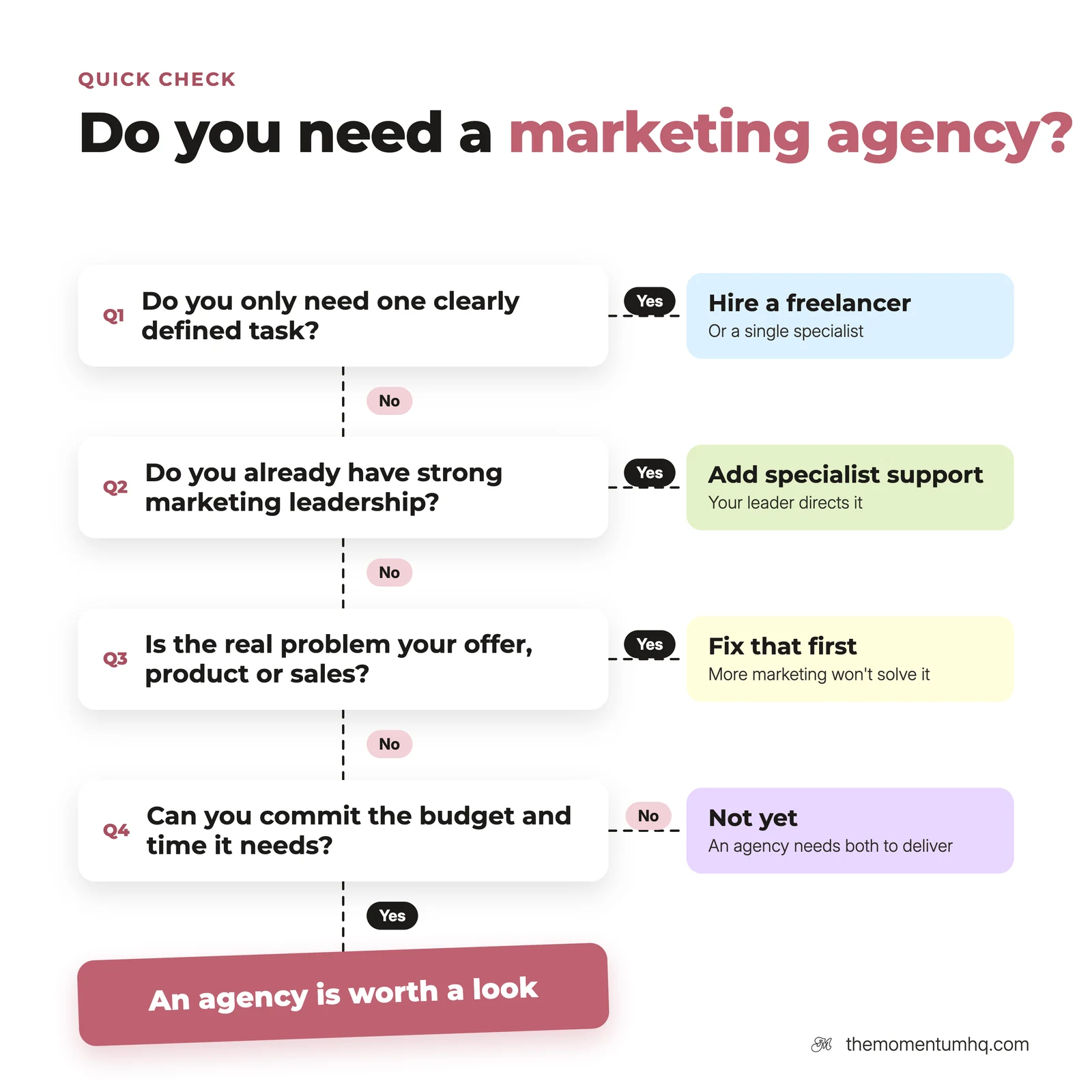
Do You Need a Marketing Agency?
Not every business needs a marketing agency. The better question is whether your current team has the strategy, expertise, capacity, and leadership needed to achieve your marketing goals.
An agency may be worth considering if:
- Marketing has become too complex to manage internally. Your business may have started with a founder or generalist handling social media and email, but now needs SEO, content, paid acquisition, reporting, and a clearer marketing strategy.
- You have execution but lack strategic direction. Your team may be producing content, running campaigns, and posting on social media without a clear connection between those activities and your business goals.
- You need senior marketing expertise without a full-time hire. A growth-stage company may need someone to set priorities, refine positioning, manage the broader marketing function, and guide execution before it makes sense to hire a full-time CMO.
- You need several capabilities at the same time. Hiring separate specialists for content, SEO, paid media, social, and analytics can create more coordination work. An agency can bring these capabilities together under one strategy.
- Your marketing workload changes over time. A product launch, new market entry, or major campaign may require more capacity than your internal team can provide on a permanent basis.
An agency may not be the best fit if:
- You only need one clearly defined task. If you already know what needs to be done and simply need someone to execute it, a freelancer or specialist may be more appropriate.
- You already have strong marketing leadership. An experienced internal marketing leader may only need additional specialist support rather than another team to manage.
- Your core marketing problem isn't actually marketing. An unclear offer, weak product-market fit, ineffective sales process, or poorly defined audience cannot be fixed simply by increasing marketing activity.
- You aren't ready to invest in marketing. An agency can provide expertise and capacity, but it still requires time, budget, internal collaboration, and enough commitment to execute the work properly.
The decision comes down to the gap between what your business needs from marketing and what your current team can realistically provide. Once that gap is clear, you can determine whether an agency, freelancer, consultant, fractional CMO, or in-house hire is the right way to fill it.
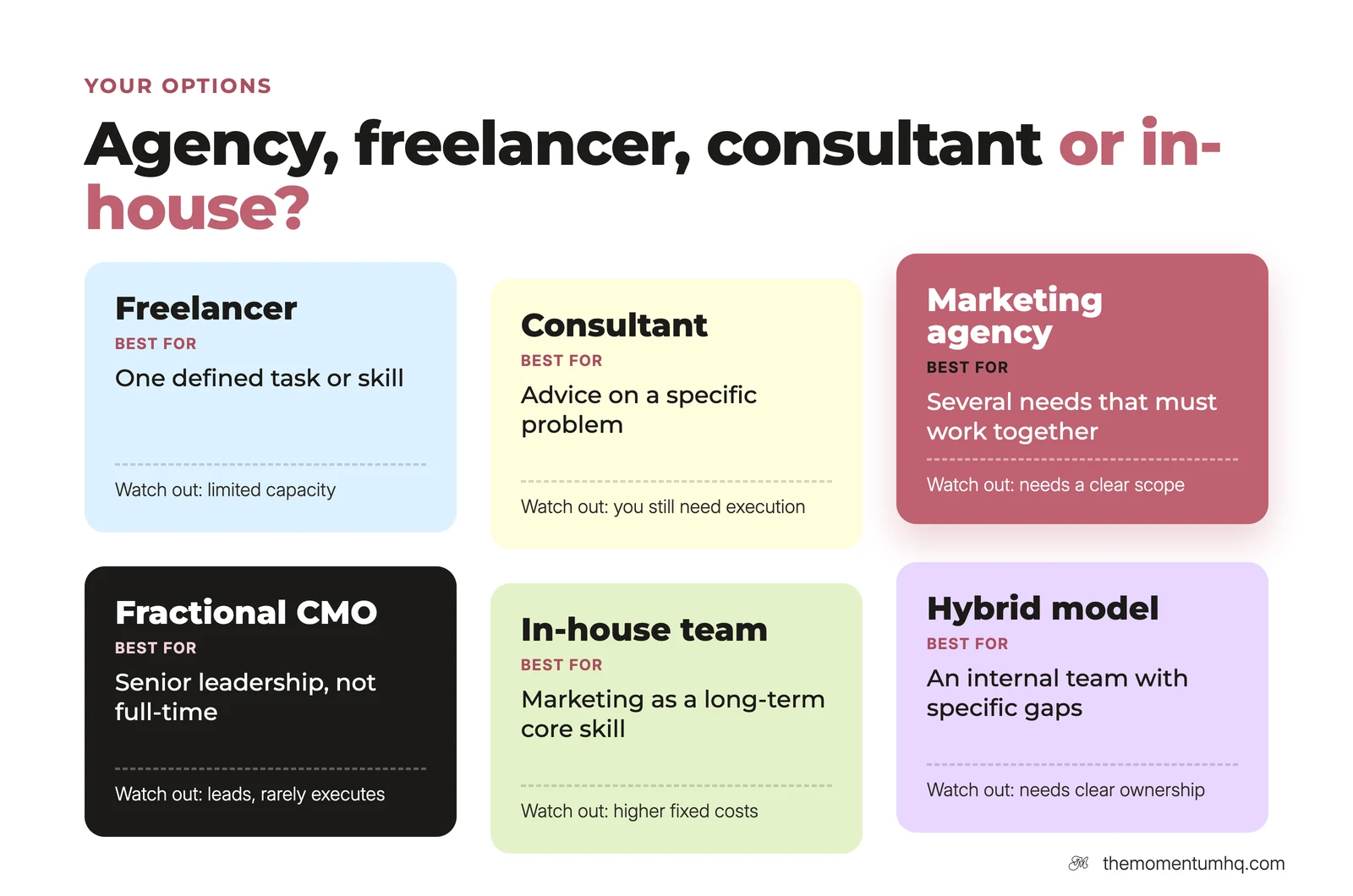
Marketing Agency vs. Freelancer vs. Consultant vs. In-House Team
There are several ways to add marketing capability to a business, and an agency is only one of them. Here are the differences between a marketing agency and other marketing solutions:
| Option | Best for | What you get | Limitations |
|---|---|---|---|
| Freelancer | A specific skill or defined marketing task | Direct access to an individual specialist for work such as content writing, design, SEO, or paid media | Limited capacity and usually less breadth across marketing disciplines |
| Consultant | Strategic advice or a specific marketing problem | Experienced guidance, analysis, recommendations, and a plan for what to do next | You may still need an internal team or external specialists to execute the recommendations |
| Marketing agency | Multiple marketing needs that need to work together | A team with expertise across several disciplines, often combining strategy and execution | Requires clear scope and coordination to avoid paying for services the business does not actually need |
| Fractional CMO | Senior marketing leadership without a full-time executive | Strategic leadership, prioritization, decision-making, and oversight of internal or external marketing resources | Usually provides leadership rather than a complete execution team |
| In-house team | Marketing as a core, long-term internal capability | Dedicated employees with deep knowledge of the business, customers, and internal teams | Higher fixed costs and responsibility for recruiting, managing, and retaining the required expertise |
| Hybrid model | Businesses with internal capability but specific gaps | A combination of internal employees and external specialists or agencies | Requires clear ownership and communication between internal and external teams |
The boundaries between these models are not always fixed. An agency can provide strategic leadership, a consultant can become closely involved in execution, and a fractional CMO can manage external specialists.
The key is to identify the capability you are missing before deciding who to hire. If you need one person to complete a defined task, a freelancer may be enough; if you need several capabilities working under one strategy, an agency may be a better fit.
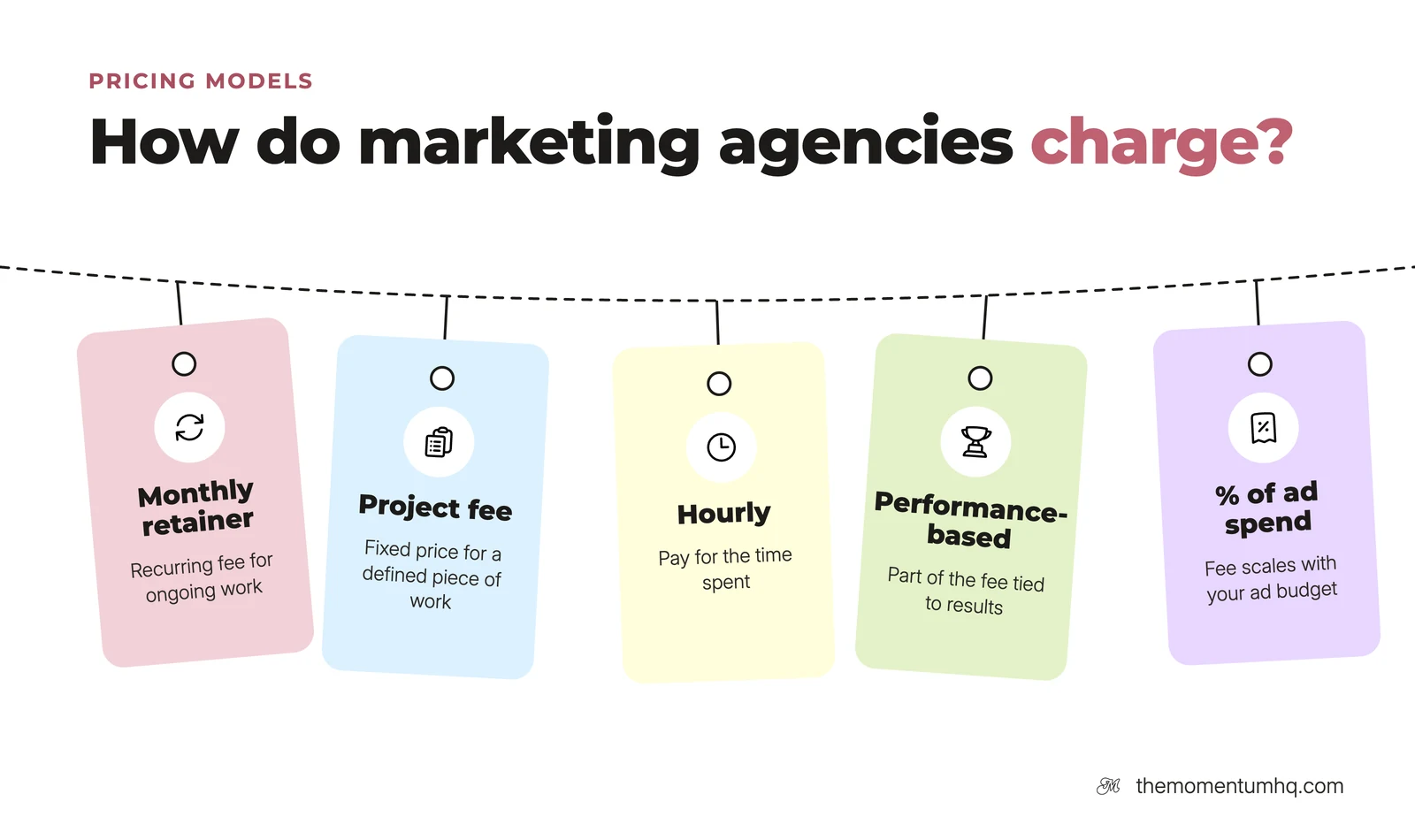
How Much Does a Marketing Agency Cost?
There is no standard price for working with a marketing agency. Costs vary based on the agency's expertise, the services involved, the amount of work required, the business's goals, and whether the engagement is project-based or ongoing.
Most agencies use one of several pricing models:
- Monthly retainer: A recurring fee for an agreed scope of work or level of support. This is common when an agency manages marketing on an ongoing basis.
- Project-based pricing: A fixed fee for a defined piece of work, such as a website, brand strategy, SEO project, or marketing plan. It can be easier to budget for when the scope is clear.
- Hourly pricing: The client pays for the time the agency spends on the work. This can suit smaller or less predictable engagements, although the final cost depends on how much time the work requires.
- Performance-based pricing: Part of the agency's compensation is tied to agreed performance measures. These arrangements require clearly defined metrics and an understanding of which factors the agency can actually influence.
- Percentage of ad spend: Common for paid media management, where the agency's fee is calculated partly or entirely from the amount spent on advertising. The fee structure should be evaluated separately from the advertising budget itself.
What you pay also depends on what you are actually buying. A low-cost engagement that covers content production is not directly comparable with a higher-cost engagement that includes marketing strategy, senior leadership, multiple specialists, and ongoing execution.
For growth-stage companies, the more useful comparison is often the cost of the capability rather than the cost of the agency alone. Building the same expertise internally can mean hiring several specialists, a marketing leader, or both, along with the costs of recruiting, salaries, benefits, management, and tools.
How to Choose the Right Marketing Agency
Choosing a marketing agency is less about finding the agency with the longest service list and more about finding one that fits your business, goals, and working style. Before comparing agencies, be clear about the problem you need them to solve and how much responsibility you expect them to take on.
How to Choose the Right Marketing Agency
- 01Define your needsChannel, project, strategy, or full support.
- 02Check relevant experienceSimilar audiences, business models, stages, or challenges.
- 03Evaluate strategy and teamAssess the thinking, senior involvement, and who does the work.
- 04Measure meaningful outcomesTrack leads, pipeline, revenue, acquisition cost, or conversions.
- 05Clarify the partnershipAlign on scope, ownership, communication, and constructive challenge.
Define what you actually need first
Start by identifying the gap in your current marketing function. Do you need help with one channel, a specific project, broader execution, strategic direction, or someone to coordinate the entire function?
For example, a company with a strong internal marketing team may only need an SEO specialist, while a growth-stage company with limited internal capacity may need broader strategic and executional support.
Look for relevant experience
Look beyond whether an agency has worked with companies in your exact industry. Consider whether it has experience with similar business models, audiences, growth stages, or marketing challenges.
For a B2B software company, for example, experience marketing to long buying cycles and multiple decision-makers may be more relevant than simply having worked with another software company.
Evaluate strategic depth
Ask how the agency approaches strategy before discussing the number of deliverables it can produce. A capable partner should be able to explain how it would understand your audience, positioning, goals, competitive environment, and marketing priorities.
You want an agency that can explain why a particular approach makes sense, not just what it plans to produce.
Understand who will actually work on your account
The people involved in selling an engagement are not always the people who deliver it. Ask who will develop the strategy, who will manage the day-to-day work, and how much access you will have to senior team members.
This matters particularly when you are paying for senior expertise. A large team does not necessarily mean you will receive more experienced thinking.
Ask how success will be measured
Find out which metrics the agency will track and how those metrics connect to your business objectives. Depending on the engagement, that could include qualified leads, pipeline, revenue, customer acquisition cost, conversions, search visibility, or other meaningful indicators.
Be cautious if an agency focuses heavily on metrics such as impressions or follower growth without explaining how they relate to the outcomes you care about.
Clarify scope, ownership, and communication
Before signing, establish what the agency will do, what your internal team needs to provide, who owns the resulting work and accounts, and how communication will work.
Clear expectations around deliverables, approvals, timelines, reporting, meetings, and responsibilities can prevent problems later.
Look for a partner that challenges your thinking
An agency should not simply agree with every request. If the team sees a better approach, it should be able to explain its reasoning and raise concerns when a proposed tactic does not support the wider strategy.
The best working relationship is not one where the agency simply takes orders. It is one where both sides can question assumptions and make better marketing decisions together.
AI Overviews now reach more than 2.5 billion monthly active users, while AI Mode has surpassed 1 billion—AI-assisted search is becoming a real part of how buyers find information.
How AI Is Changing Marketing Agencies
AI is changing both how marketing work gets done and how buyers discover information. Google says AI Overviews now reach more than 2.5 billion monthly active users, while AI Mode has surpassed 1 billion monthly users, showing that AI-assisted search is becoming a significant part of the search landscape.
For agencies, this means some executional work can be completed faster. AI can assist with research, analysis, content development, and other repetitive tasks, but Google's own guidance stresses that businesses should focus on unique, valuable, non-commodity content rather than producing large volumes of low-value material with AI.
AI is also changing how agencies approach search. Traditional SEO remains important for visibility in AI Overviews and AI Mode, and Google says there are no separate technical requirements or special “GEO” tactics needed to appear in these features. The fundamentals still matter: accessible websites, useful content, strong information, and sound SEO practices.
For marketing agencies, the implication is less about replacing marketers with AI and more about using it to improve how marketing gets done. As routine execution becomes easier to automate, strategic thinking, subject-matter expertise, positioning, judgment, and the ability to connect marketing activity to business goals become increasingly important.
Final Thoughts
A good marketing agency should bring more than additional execution capacity. It should understand the business, establish clear priorities, connect different marketing activities to those priorities, and use performance data to make better decisions over time.
For growth-stage companies, that often means finding the right balance between senior marketing thinking and practical execution. You may not need to hire a full-time CMO and build an entire marketing department, but you may have outgrown relying on individual freelancers or managing marketing yourself.
That is the gap Momentum is built to fill. We work with B2B founders and growth-stage companies as an outsourced marketing function, bringing senior strategy together with content, social, search, and other specialist capabilities. If your business has real growth opportunity but needs more marketing expertise and capacity than its current team can provide, reach out to us today.