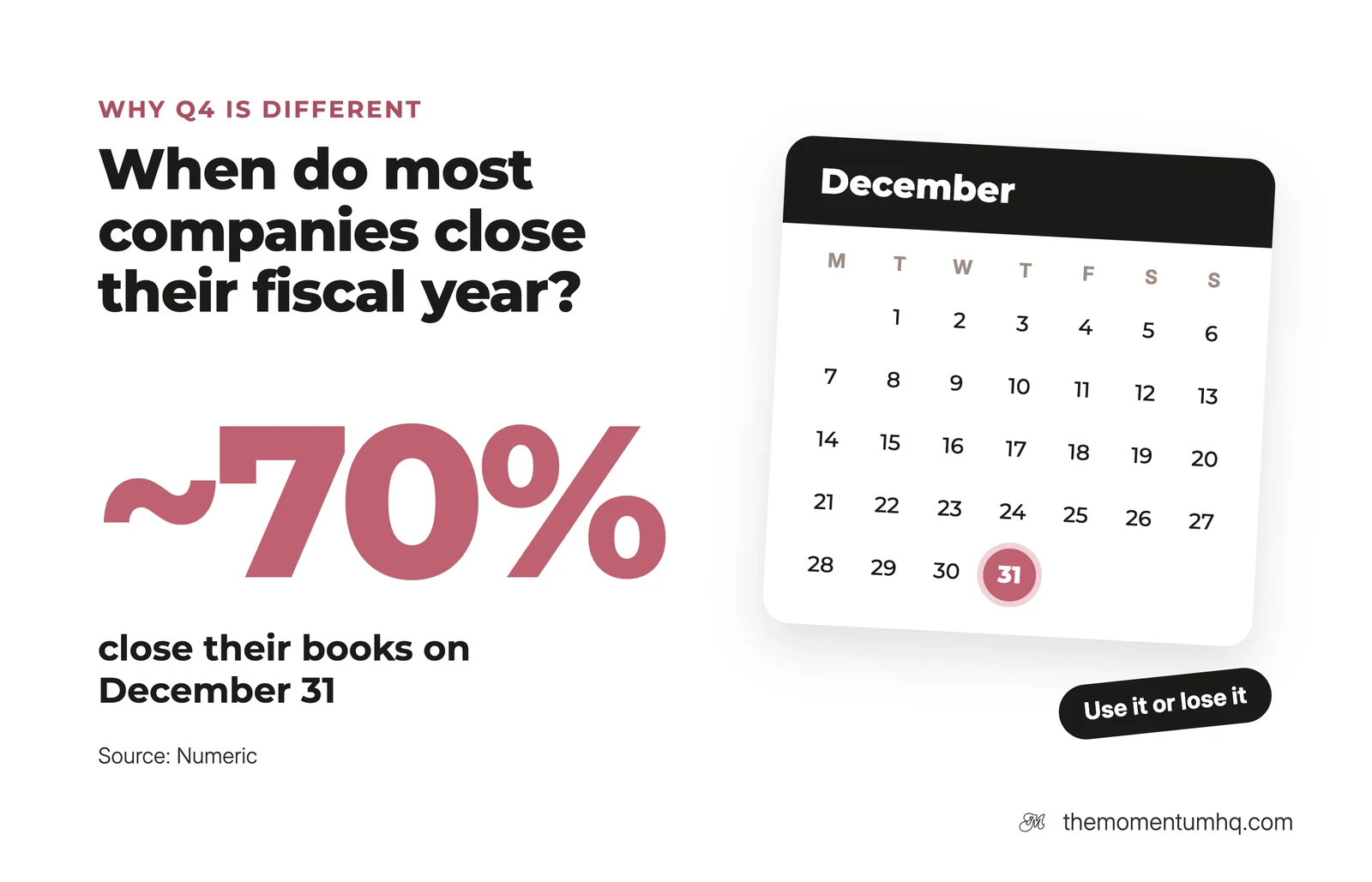
Most B2B marketing teams run Q4 like a slower Q3 with a holiday theme. The buyers they're targeting are behaving completely differently. Almost 70% of companies close their fiscal year on December 31.
In other words, Q4 is when buyers are spending what's left of this year's budget and fighting for next year's at the same time. A marketing plan built for the other three quarters misses both. So if you’re looking to boost the Q4 marketing for B2B models, these are the six moves that can separate you:
6 Q4 marketing moves to make in B2B
None of these moves need a bigger budget or a new team. They're focused on pointing what you already have at the quarter your buyers are actually in. Here's where to start:
1. Shift spend toward existing pipeline
Move budget from top-of-funnel demand generation (reaching buyers who don't know you yet) to bottom-of-funnel acceleration (helping prospects already evaluating you sign). Q4 buyers are either rushing to spend before year-end or stuck in budget reviews, and both favour vendors already in the conversation.
Enterprise deals slow down in November and December. Forrester's 2026 buying research puts the typical decision at 13 internal stakeholders and nine external influencers, and holidays pull those people out for days at a time. Plus, 89% of buyers had a purchase stall, often because of budget limits. A deal that stalls in mid-December usually restarts in February with a new budget.
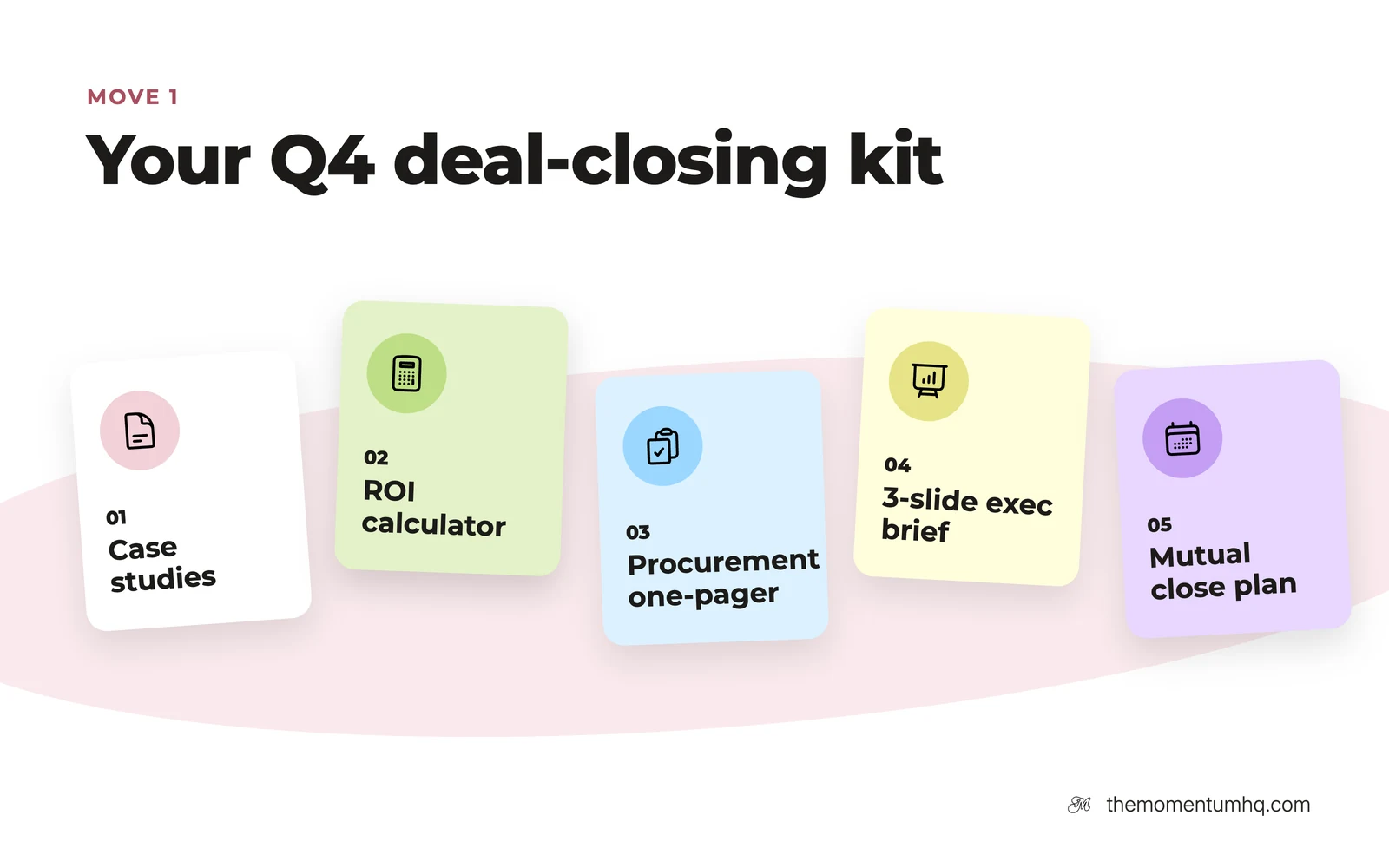
Put the reallocated spend into assets that move a deal forward when your sales team isn't in the room:
- Industry-matched case studies, so the champion can show a company like theirs got results.
- An ROI or cost calculator the buyer can take straight to finance.
- A procurement one-pager covering security, pricing, contract terms and onboarding.
- A 3-slide executive brief for the CFO or CEO meeting you won't be invited to.
- A mutual close plan mapping every remaining approval against the December calendar.
Don't cut top-of-funnel to zero, though. The winning vendor is already on the buyer's Day One shortlist 95% of the time, according to 6sense. Buyers who don't hear from you this quarter are less likely to put you on next year's shortlist. Cut short-term lead capture like gated ebooks, and keep brand activity running at a lower baseline.
Want a second opinion on your Q4 budget mix? Book a 20-minute Q4 review with Momentum.
2. Get ahead of the "predictions" content glut
Instead of 2027 predictions, publish a data-backed retrospective: what your industry predicted for 2026, what actually happened, and your own client or performance data as proof. Readers can check a retrospective against reality. A prediction can't be checked until it no longer matters.
Every December, feeds fill with near-identical trend posts that buyers scroll straight past. A retrospective stands out because it's built on data nobody else has. Spotify Wrapped runs on the same idea, and most B2B companies sit on equivalent raw material in their client results and sales calls.
Here are some steps to build one:
- Collect 5–10 widely shared predictions about your category from late 2025, with links.
- Score each one against what actually happened.
- Add your own evidence from client results, benchmarks or sales conversations.
- Close with what the gaps mean for next year's plans.
Publish it in November, before the predictions glut peaks. Original data also makes ChatGPT and Perplexity far more likely to cite you than the thousandth trends list.
3. Target the budget-planning conversation directly
Q4 is when buyers write next year's budget proposals, so publish content they can lift straight into them. A vendor whose numbers end up in a buyer's board deck is part of the plan before any RFP goes out.
By the time an RFP exists, the budget, scope, and usually the shortlist are already set. The real decision rests with an internal champion who must justify the spend to finance, and Forrester's 2026 research found buyers under immense pressure to justify investments and minimise risk. Anything that helps them make that case gets forwarded around the company.
Here are some examples that get shared this way:
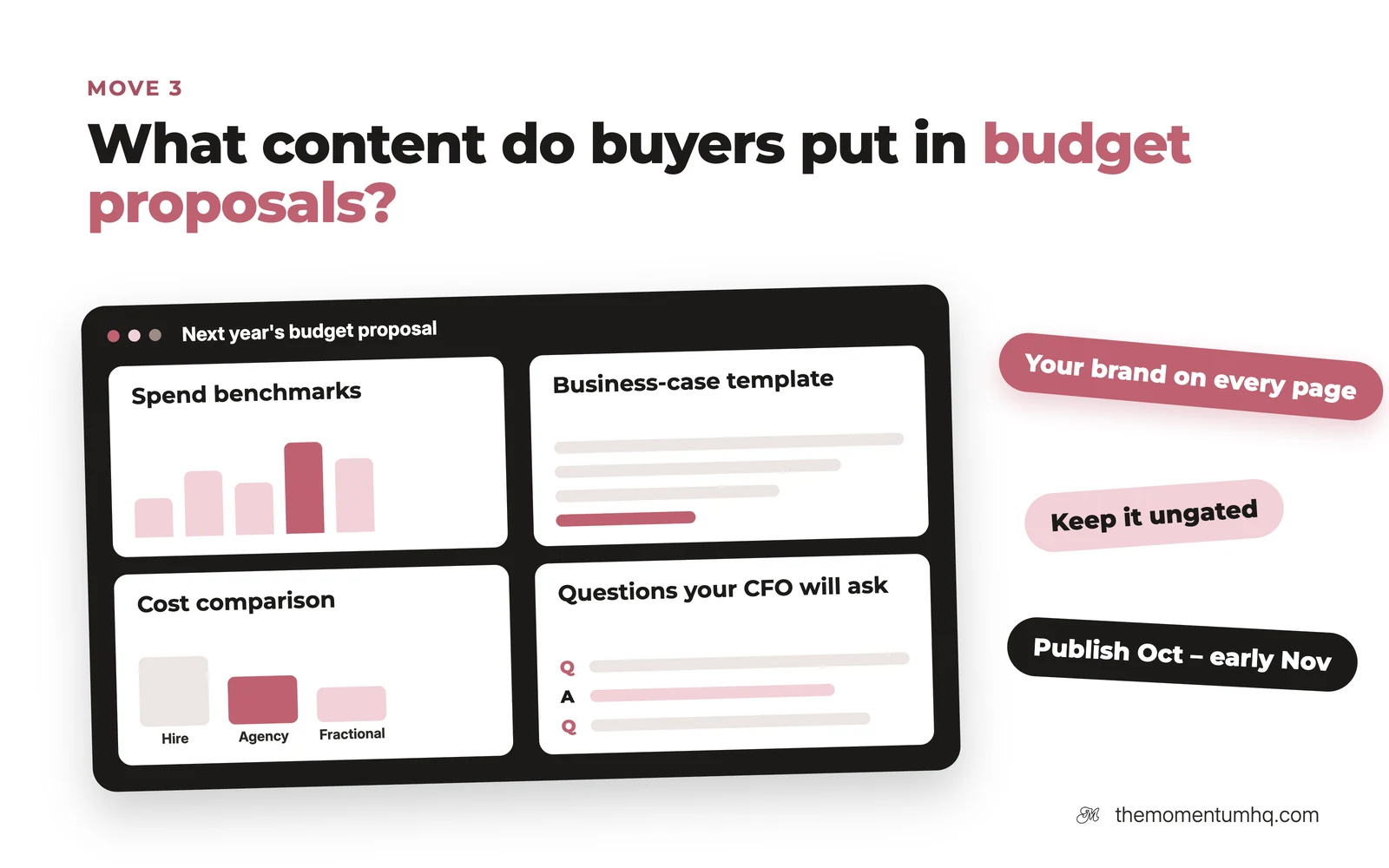
- Benchmark data on what companies at a similar stage spend and what they get for it.
- Editable business-case templates in Google Slides or Sheets, with your brand subtly on each page.
- Cost comparisons, such as a full-time hire against an agency against a fractional model.
- "Questions your CFO will ask" guides with answers the champion can use in budget review.
Keep these ungated or lightly gated, because a form stops most internal sharing. Publish them in October and early November, while planning cycles are running.
4. Treat renewals and expansion as a distinct Q4 motion
B2B marketing should own renewal and expansion content in Q4 because, for any business on calendar-year contracts, Q4 is renewal season, and renewals get decided in the same budget reviews where new spend is fought over. Content that proves value to existing customers protects revenue that is more at risk in Q4 than in any other quarter.
Most marketing teams leave renewals entirely to customer success and sales. The result is that your customer's champion walks into budget review with a renewal invoice and no evidence. Meanwhile, a competitor's sales team is sending that same champion a case study.
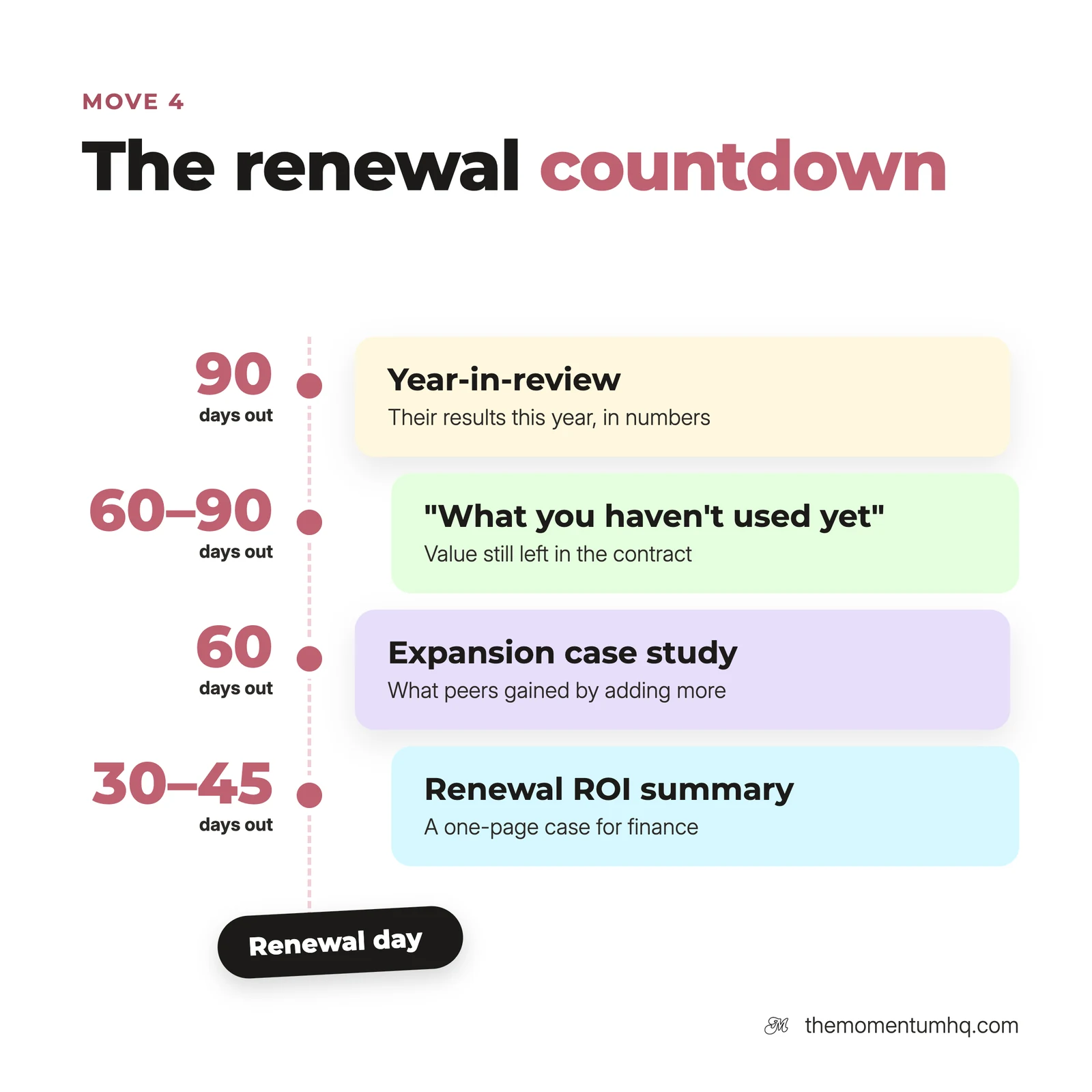
Not sure how to execute this? At Momentum, we’ve helped our clients improve renewal rate by 30% on average with this strategy:
| Content | What it proves | When to send |
|---|---|---|
| Personalised year-in-review | The results the customer got this year, in numbers | 90 days before renewal |
| "What you haven't used yet" guide | The value still available under the current contract | 60–90 days before renewal |
| Expansion case study | What customers like them gained by adding a service or tier | 60 days before renewal |
| Renewal ROI summary | A one-page business case the champion can take to finance | 30–45 days before renewal |
Build this with customer success, not around them. A shared calendar of every renewal date in the next 120 days gives marketing a production schedule and CS a set of assets to use in their conversations.
Measure it on net revenue retention and expansion revenue, not MQLs. Every renewal saved in Q4 is revenue you don't have to replace with a new pipeline in Q1.
5. Exploit the organic attention gap in late December specifically
Many B2B brands go quiet in the last two weeks of December, and the people still working notice. Late December isn't the time for paid lead generation, but it is a strong window for organic, founder-led content.
B2Linked analysed more than $185,000 of LinkedIn ad spend across the 2024 holidays and found that cost per lead rose on and around the holidays. The same analysis showed people were still reading.
Conversation ad open rates rose to about 47% between Christmas and New Year, against a normal 41%, and link clicks on thought leader ads (promoted posts from individual profiles) ran at almost double their usual rate over the break.
Here are some ideas that you can post in late December:
- Your Q4 retrospective, broken into several short posts.
- Founder reflections with specific numbers: what worked, what didn't, what you're changing.
- Planning frameworks and templates buyers can use in the first week of January.
- Nothing that reads as a hard sell. Buyers are thinking, not purchasing.
The cost is low: write and schedule the posts in early December, then check comments once a day. Most competitors hand you this window voluntarily.
6. Separate "spend it before year-end" prospects from genuine Q1 pipeline
Inbound interest often jumps in Q4, and not all of it is what it looks like. Some buyers reach out because they have a real problem to solve. Others reach out because they have budget left over and need to spend it before December 31.
The second group can look like hot leads for a few weeks, then go silent in January once the pressure lifts, usually after your sales team has put hours into calls and proposals.
Marketing is in the best position to spot the difference early, because the signals show up in how a lead comes in. A budget-driven lead:
- Talks about timing before the problem
- Asks what they can get for a set amount
- Can't tell you who else needs to approve it
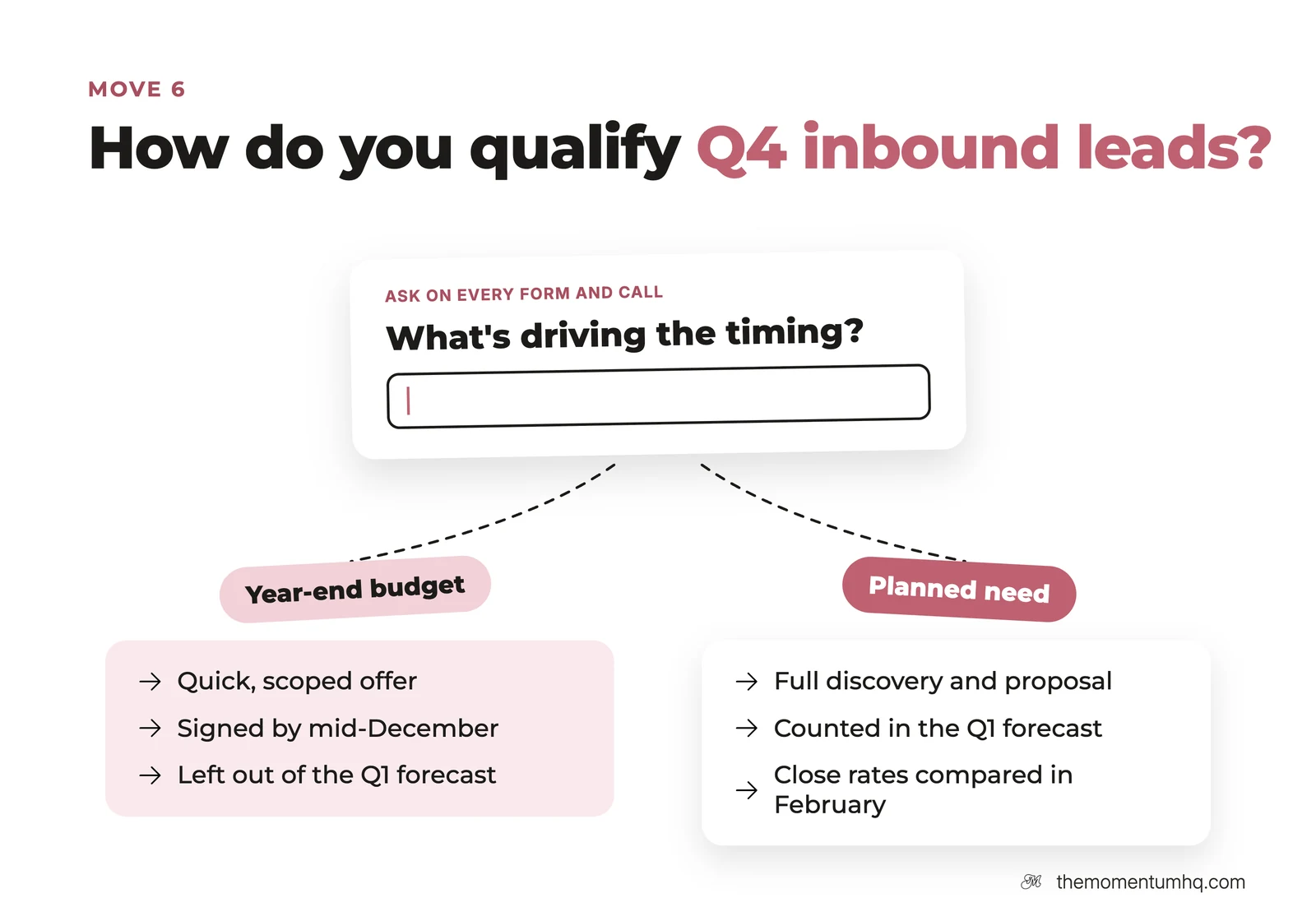
A genuine lead can explain what's broken, what it's costing them and who signs off. The simplest fix is one question on your inbound form and in every discovery call: "What's driving the timing?"
From there:
- Tag each lead in your CRM as "year-end budget" or "planned need" so sales knows what they're working with.
- Give budget-driven leads a quick, scoped offer they can sign by mid-December. If it doesn't close, book a Q1 check-in and move on.
- Leave budget-driven deals out of your Q1 forecast, then compare close rates by tag in February to see how your own numbers played out.
None of this means turning budget-driven buyers away. Some of them become great clients. The mistake is treating them like planned purchases and forecasting them that way.
Frequently asked questions
When should B2B companies start planning Q4 marketing?
B2B companies should start planning Q4 marketing in August or early September. Budget-season content needs to be live by mid-October, and renewal content needs to reach customers 90 days before their renewal date. If you're starting in October, prioritise renewal content and late-stage pipeline support first, since both protect revenue that's already within reach this year.
Should B2B companies offer year-end discounts?
B2B companies should offer year-end discounts only with a condition attached. A discount tied to signing by a set date, or to a multi-year term, uses year-end urgency without training buyers to wait for December. Where possible, add value instead of cutting price. Extra onboarding or additional seats protect your pricing for next year.
What KPIs should B2B marketing track in Q4?
In Q4, B2B marketing should track how fast deals move through the pipeline, how many close, and how much revenue it keeps and grows from existing customers. Lead volume matters less, because Q4 marketing is mostly about moving and protecting revenue you already have. Also track how often sales uses your case studies and ROI assets in live deals.
Is Q4 a good time to launch a new B2B product or service?
October is a good time to launch a new B2B product or service; mid-November to December is not. An October launch reaches buyers while they're building next year's budget. Launching in December competes with holidays and year-end closes. If your launch date is fixed late in the year, announce it in Q4 and sell it into Q1 budgets.
Where should a small B2B marketing team start if it can't do everything in Q4?
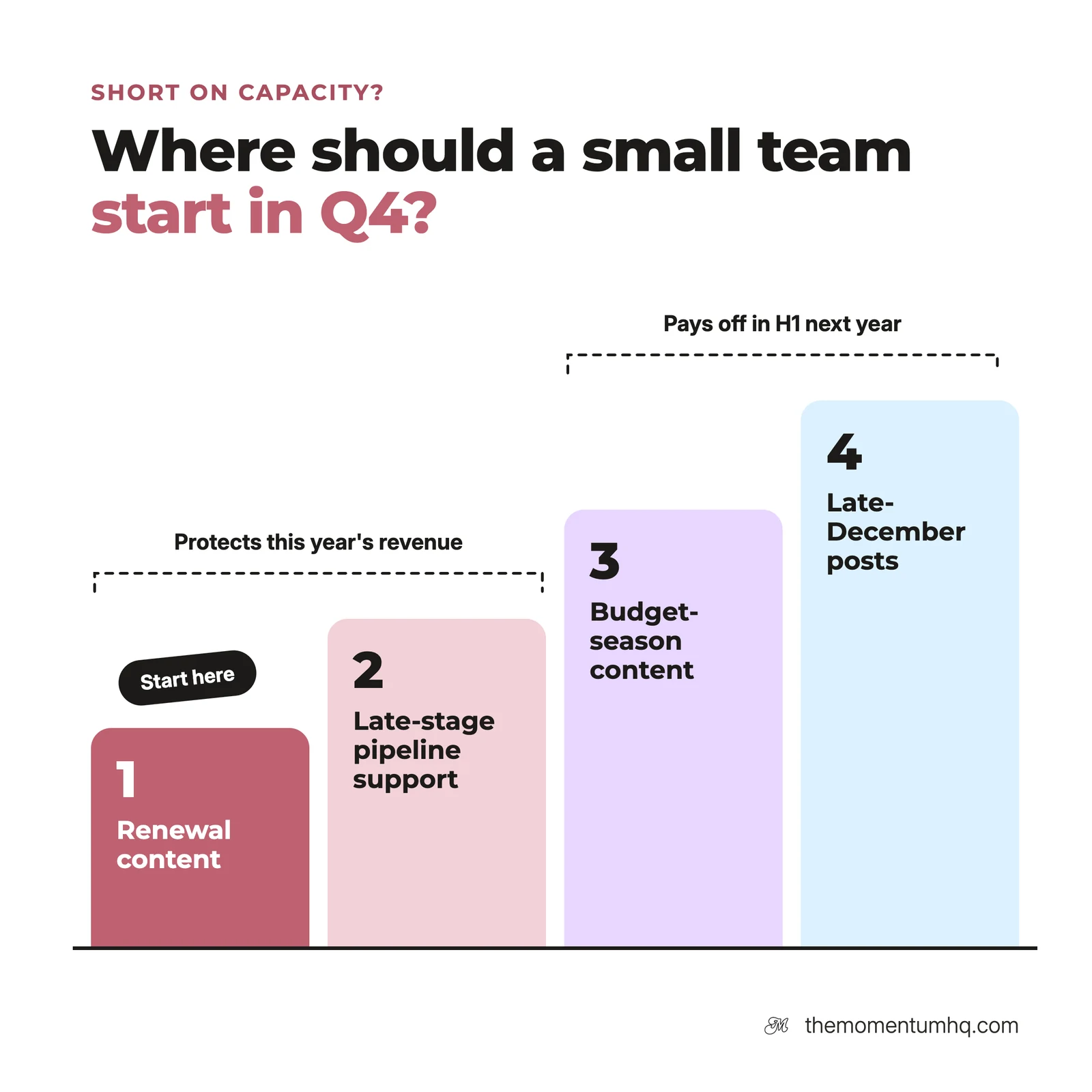
A small B2B marketing team should start with renewal content, then late-stage pipeline support. Both affect this year's revenue and mostly reuse content you already have. Budget-season content and late-December posting come next, if capacity allows, because their payoff arrives in the first half of next year.
Does B2B content published in Q4 still pay off in Q1?
Yes. Content published in October and November has time to be indexed and picked up by search engines and AI assistants before January, when many buyers restart research with fresh budgets. Budget benchmarks, cost comparisons and retrospectives stay useful well into Q1, so Q4 is a strong time to publish evergreen, data-led pieces.
Final thoughts
Q4 rewards teams that stop running the same funnel they ran in spring. Your buyers are closing deals, defending budgets, and deciding which vendors stay, and each of the six moves above meets them in one of those moments. You don't need all six to see a difference. Start with the ones closest to revenue: late-stage pipeline and renewals.
For help deciding where your Q4 budget should go, Momentum works with B2B founders and growth-stage teams on this. Book a Q4 planning call, and we'll help turn your pipeline and contract calendar into a plan you can run before December.