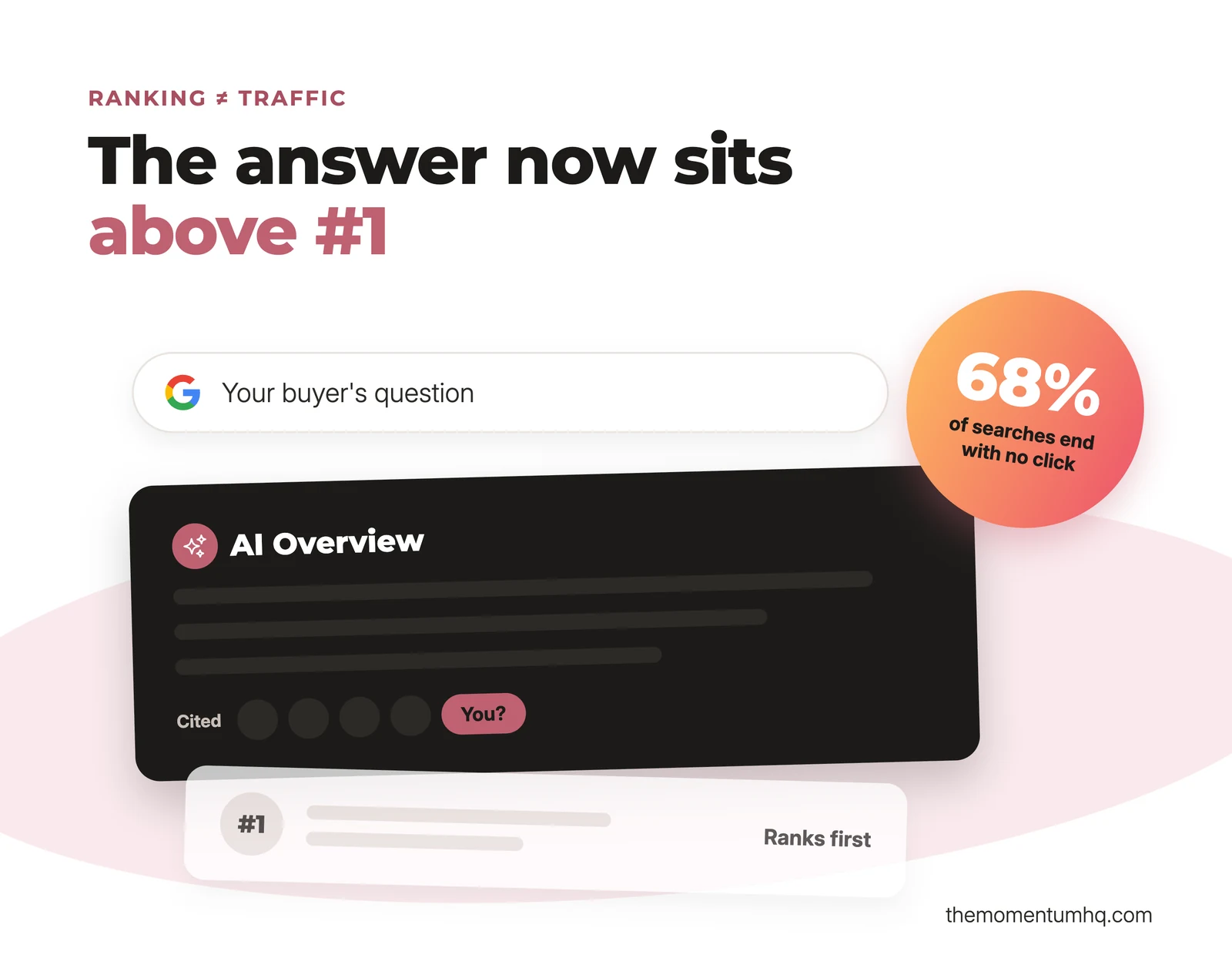
Search stopped rewarding the click a while ago. Sixty-eight percent of Google searches already end without anyone visiting a website, and on queries where an AI Overview appears, that number climbs past 80%.
That’s where zero-click searches step in. By 2027, multiple forecasts put the overall zero-click rate above 70%, with AI Overviews expanding into comparison and transactional queries that used to be reliable traffic.
Brands that understand this early are building the kind of content and credibility that earns a spot in that citation set, turning what looks like a traffic decline into a genuine visibility gain. This piece covers how AI systems choose what to cite, why that behavior only grows heading into 2027, and how to optimize for zero-click searches so that your brand is inside the answer.
What is zero-click search?
A zero-click search is any query that gets fully answered on the results page itself, with no need to visit a website. The searcher gets a definition, a stat, a comparison, or a recommendation directly from Google, and the search ends there.
This isn't new behavior. Featured snippets, knowledge panels, and "People Also Ask" boxes have pulled traffic away from websites for years by answering the query with content lifted from a single page.
AI Overviews work differently. Instead of surfacing one page's answer, they generate a new response built from several sources at once, written in natural language, with no guarantee any single source gets named or clicked.
How big is zero-click search going into 2027?
Sixty-eight percent is a US average across every kind of query. Narrow it down to where AI shows up, and the number moves fast. In Google's AI Mode, 93% of searches end without a click to any website, because the entire interface is built around a conversational answer instead of a page of results to browse.
That's the direction the rest of search is heading. Google has already said it plans to extend AI Overviews into comparison queries and eventually transactional ones, the exact categories that used to reliably send buyers to a website. Forecasts for 2027 put the overall zero-click rate between 70% and 85%, and the jump from 2024 to 2026 alone is already the fastest two-year acceleration the industry has tracked.
None of the forces behind that growth is slowing down. AI Mode adoption is still early. AI Overview coverage is still expanding into new query types. None of the major AI search platforms, ChatGPT Search and Perplexity included, were built with ten blue links as a fallback.
Why ranking #1 no longer guarantees traffic
Ranking has always assumed a straight line from position to clicks. That line breaks once an AI Overview answers the query above the results themselves.
A few reasons explain why the position itself stopped being the deciding factor:
- The answer now sits above the results. An AI Overview occupies the space a searcher used to scan before reaching position one, so the click gets intercepted before ranking ever comes into play.
- Citation is a separate selection, not a ranking outcome. AI Overviews pull from a handful of sources judged credible enough to cite, and that judgment doesn't automatically favor whoever ranks highest in the organic results below it.
- One answer can satisfy searchers regardless of who wrote it. If the AI Overview fully resolves the query, the searcher has no reason to click through and verify it, no matter how well any individual page ranks.
- Google is extending this behavior into higher-intent queries. Comparison and transactional searches, the categories that used to protect a strong ranking position, are the same categories Google has said it plans to bring AI Overviews into next.
Being one of the handful of sources an AI system trusts enough to cite now carries more weight than beating a competitor to position one.
How do AI Overviews choose what to cite?
Getting cited inside an AI Overview isn't the same contest as ranking on the page below it. The selection process runs on its own logic, and understanding that logic is what separates brands that show up inside the answer from brands that only show up underneath it.
Multi-source assembly vs. single "best" result
Traditional ranking crowns one page as the top answer. AI Overviews don't work that way. They typically pull from five or six sources at once, blending them into a single response, which means the system isn't looking for the single best page so much as a set of sources that collectively cover the query with enough consistency to feel reliable.
A page can be genuinely excellent and still get left out if it says something no other credible source corroborates, or if a handful of other pages already cover the same ground more completely.
The role of E-E-A-T and entity signals
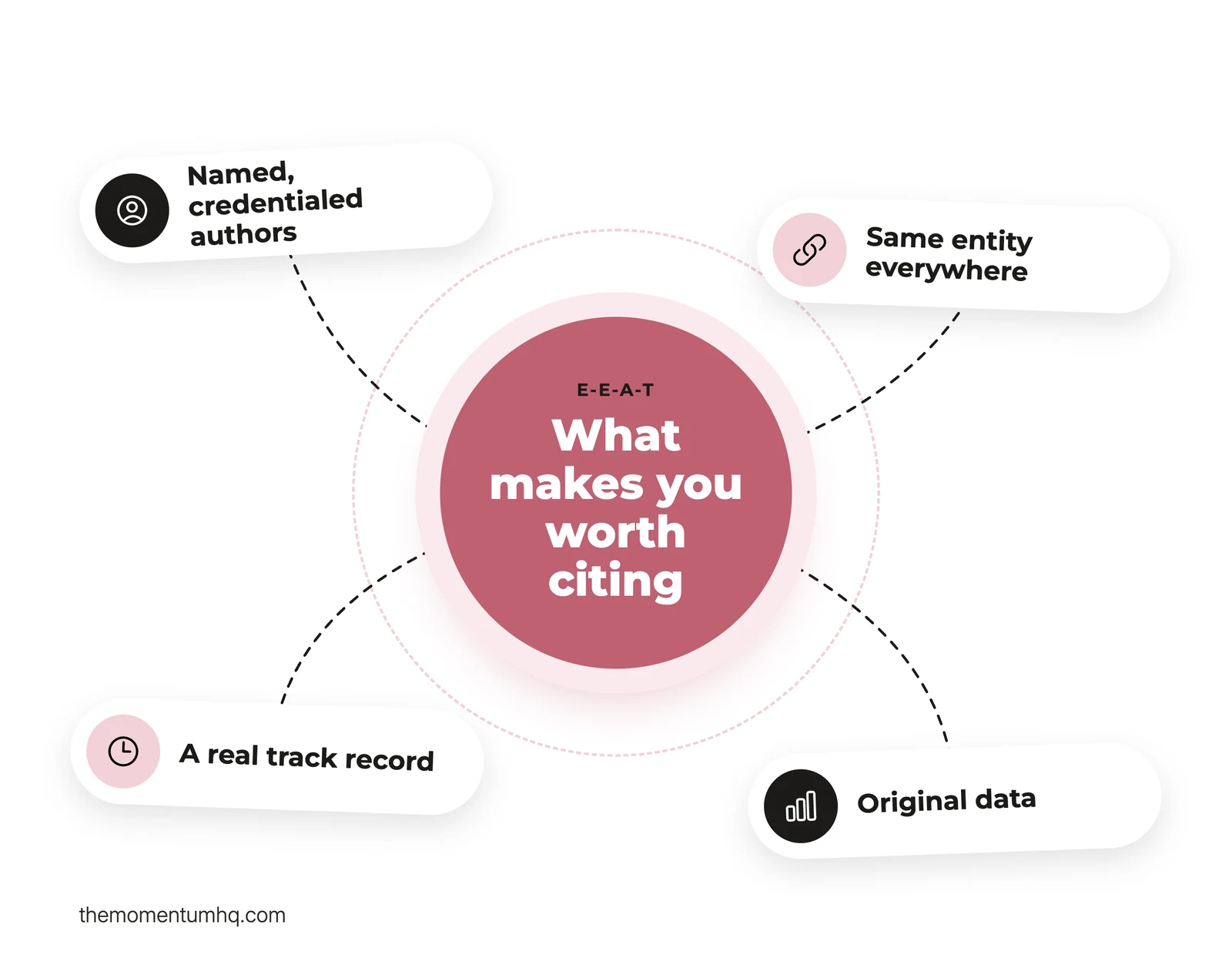
The signals that decide whether you are in AI Overviews look a lot like what Google has spent years calling E-E-A-T:
- Real authorship with visible credentials. A named author with relevant expertise reads as a more trustworthy source than unattributed or generic-byline content.
- Consistent entity presence across platforms. A brand that shows up the same way across its site, LinkedIn, and other authoritative platforms is easier for an AI system to recognize and trust as a stable, real source.
- A track record that reads as credible, not assembled overnight. Domain history, depth of coverage on a topic, and consistency over time all signal the kind of authority a brand-new page can't fake.
- Original data and proprietary research. A statistic no other source has is a genuine reason to be cited rather than one of several interchangeable options saying the same thing.
Getting cited inside an AI Overview comes down to whether a brand looks like a source worth trusting. Build enough of these signals, and the citation follows on its own.
How to increase your visibility in zero-click searches
Increasing your AI visibility isn’t as easy as it might sound. The probability comes down to a specific set of structural, editorial, and authority moves, most of which have little to do with traditional keyword optimization.
Here are the steps to take to increase your zero-click search visibility:
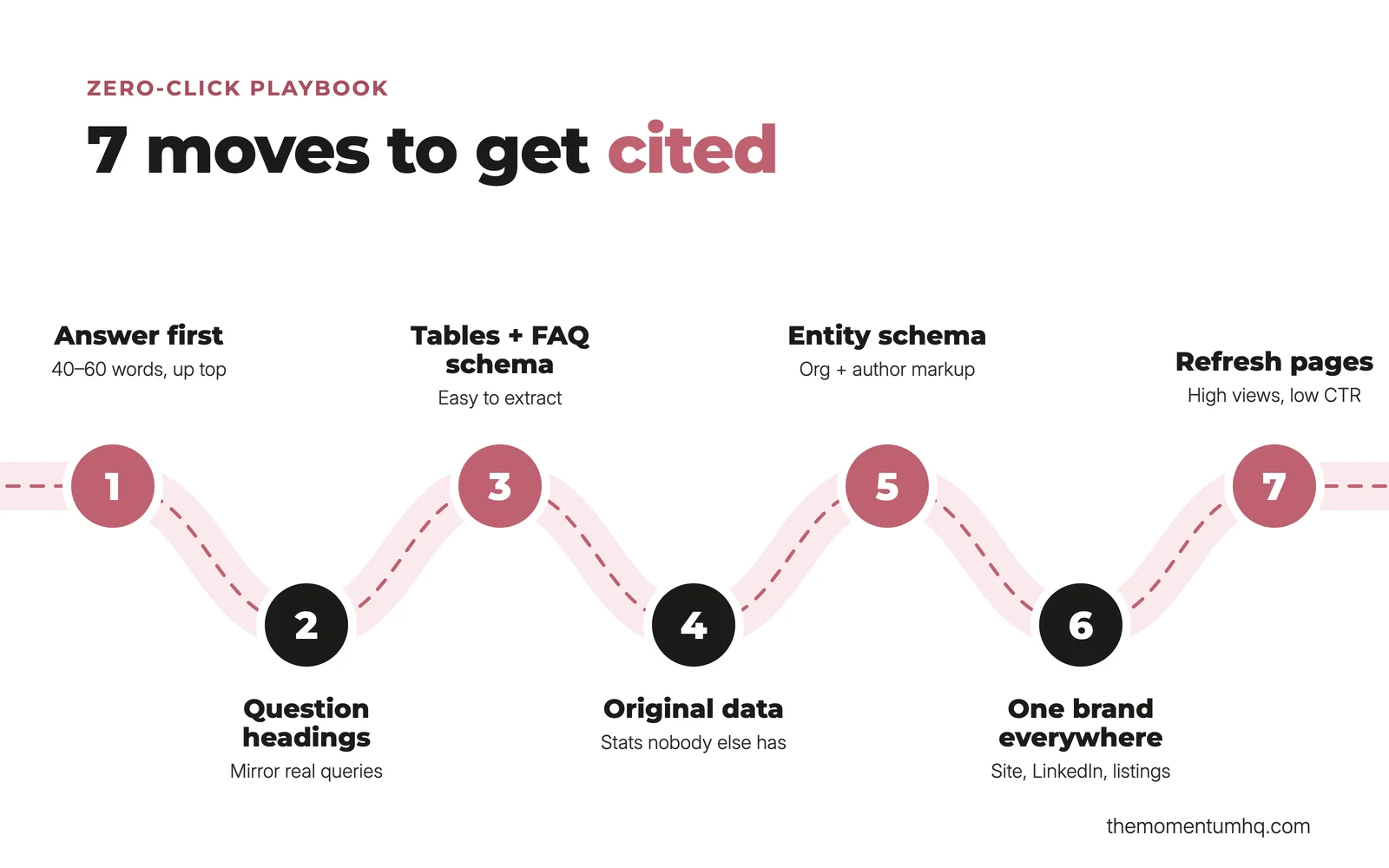
1. Lead with a direct, extractable answer (40–60 words)
Answer the core question in the first 40 to 60 words of the section, before any setup or context gets in the way. That block should stand alone as a citation, complete enough that an AI system could lift it without needing the rest of the paragraph to make sense.
Save narrative, examples, or a hook for after the answer, not before it. A useful test is reading just those first two sentences on their own: if they fully answer the query without the reader needing more, the block is ready.
2. Structure headings around real sub-questions
Base headings on the actual questions people ask about the topic, pulled from People Also Ask results, forums, or even sales call transcripts, rather than headings written to sound comprehensive.
Each distinct sub-question deserves its own heading instead of getting folded into a broader section where it's harder to extract cleanly. Phrase the heading the way a person would type or speak the query, and nest H3s under the H2 they support so the structure maps to how AI systems parse the page.
3. Add comparison tables and FAQ schema
Any content built around "X vs Y" or "which option is better" reads more clearly as an actual table than as a paragraph describing the differences, and tables extract more cleanly for AI systems assembling a comparison answer.
Where a section is already formatted as a question and answer, add an FAQPage schema so it's eligible for that kind of extraction. Keep each FAQ answer to two or four sentences, direct and complete without depending on the surrounding page, and validate the schema before publishing to confirm it's structured correctly.
4. Publish original data or proprietary research
Client outcomes, internal surveys, and proprietary benchmarks carry more citation weight than another summary of third-party studies everyone else is already citing.
Frame each data point as a specific, named finding rather than a general claim, and refresh that research on a set cadence so the numbers don't go stale by the time a system might reference them. Attribute the number clearly enough that another source citing it later would credit it back to you.
5. Strengthen entity signals with organization and author schema
Add Organization schema with a consistent name, logo, and set of social profiles across every page, and Author schema with a real bio and credentials wherever expertise matters to the reader.
Link author profiles across the site so the entity is traceable from one consistent source rather than scattered across inconsistent bylines. The same author name and title should show up identically everywhere it appears, on-site and off.
6. Keep your brand consistent across platforms
The same brand name, description, and positioning should carry across your site, LinkedIn, and any third-party listings that mention you, since inconsistency here reads as a weaker entity signal to the systems trying to verify who you are.
Correct outdated or inconsistent mentions on directories and partner sites wherever you have the ability to, and make sure your LinkedIn company page and executive profiles reflect the same expertise claims made on your site.
It's also worth periodically checking how your brand gets described on platforms you don't control, so discrepancies get caught before they compound.
7. Refresh and re-optimize existing high-impression pages
Search Console data will usually show you exactly where to start: pages with high impressions and a falling click-through rate are a common sign that an AI Overview has started answering that query directly.
Rather than building a new page from scratch, rebuild the top of the existing one with a direct, extractable answer, and add whatever else is missing, whether that's schema, a comparison table, or an FAQ section. A few weeks after republishing, recheck your AI Overview presence for the target query to confirm the update actually worked.
Where should you optimize besides Google?
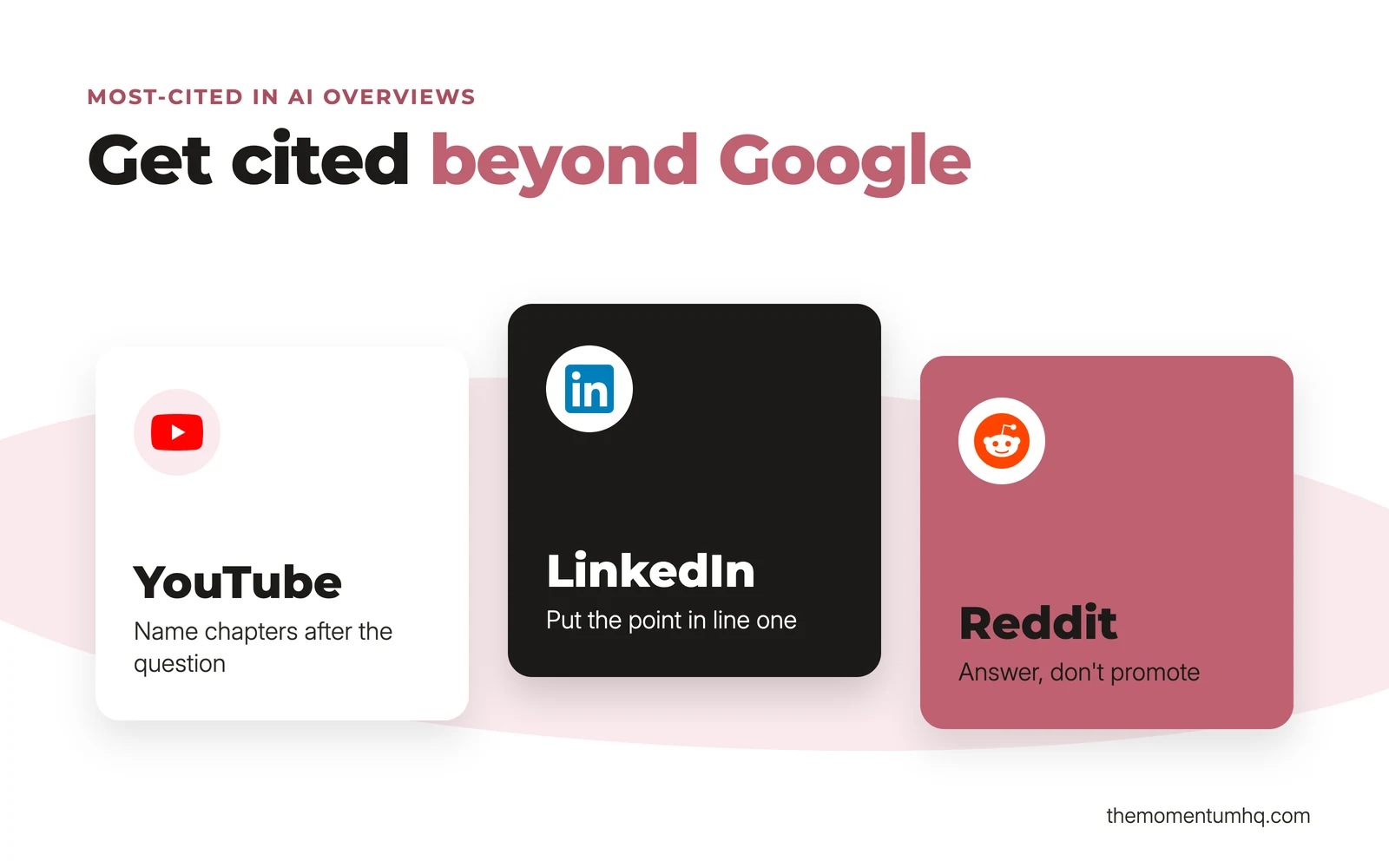
AI Overviews don't source exclusively from pages competing in Google's own organic results. Ahrefs' 2026 data found that YouTube, LinkedIn, and Reddit are the three most frequently cited sources inside AI Overviews, which means a content plan built entirely around ranking on Google is missing a real share of where these systems are pulling their answers from.
That reframes distribution as part of the optimization work itself, not a separate marketing motion running alongside it.
- YouTube. Video content that directly answers a specific question is increasingly pulled into AI-generated answers alongside written sources, especially for how-to and comparison queries. Structure video descriptions and chapter titles around the exact question the video answers, the same way you'd structure a heading on a blog post.
- LinkedIn. As one of the most consistently cited platforms in B2B-relevant AI Overviews, LinkedIn posts that state a clear, specific point tend to outperform posts written mainly for engagement. Write posts the way you'd write an extractable answer block, with the point in the first line, not buried under a hook.
- Reddit. Reddit threads carry a kind of unfiltered credibility that AI systems appear to weight heavily on comparison and recommendation queries. Contribute genuinely useful answers in threads relevant to your category rather than posting promotional content, since AI systems are pulling the substance of what's said, not who said it.
How should you measure zero-click performance?
Sessions and click-through rate were built to measure a search environment that answered fewer questions on its own. Neither metric tells you whether your brand made the AI's citation list, which is the number that predicts whether this work is paying off.
These 4 KPIs can help you measure your zero-click performance:
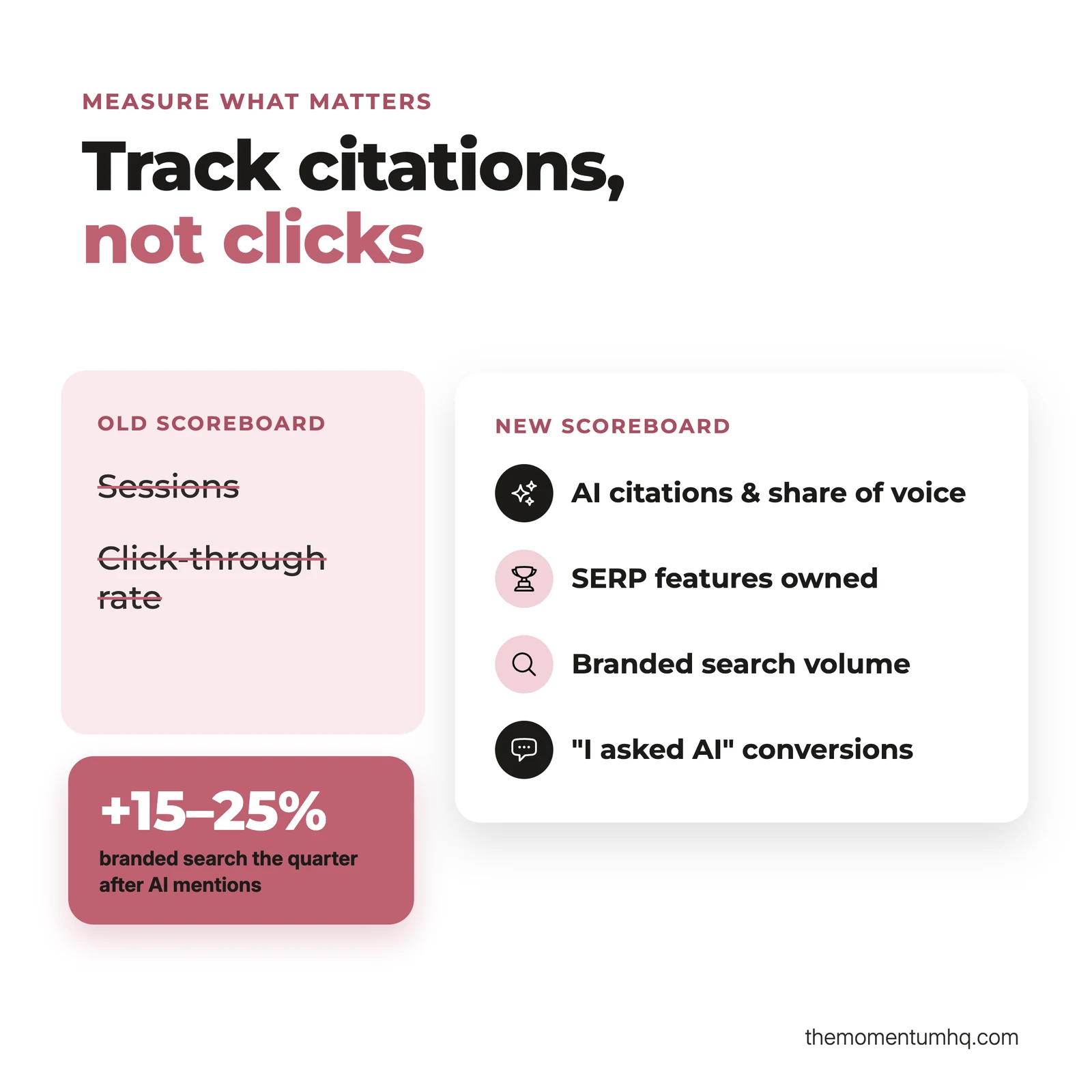
AI citations and share of voice
Track how often AI tools like ChatGPT, Perplexity, and Google's AI Overviews mention your brand when answering a question relevant to your category, not just whether you rank for the keyword tied to it.
Tools like the Semrush AI Visibility Tool can pull this across your priority topics. Treat the result as a share-of-voice metric, how often you show up relative to competitors being cited on the same questions, rather than a single yes or no.
SERP feature ownership
Track how many featured snippets, knowledge panels, and answer boxes your content owns on the search pages you care about, alongside the AI Overview citations tracked above. A page that has lost clicks but gained an owned SERP feature hasn't failed. It converted the same visibility into a different format.
Branded search volume
Watch for increases in people searching for your brand name directly, especially following a period where you know you've picked up AI citations on a related topic. Branded search volume tends to rise 15 to 25% in the quarter following AI mention exposure, even when the original AI interaction produced no clicks at all. More branded search shows real recall instead of a passing mention.
Assisted conversions and feedback
Add a field to your contact forms or sales call intake asking how the person found you, and watch specifically for mentions of ChatGPT, an AI search tool, or "I asked AI about this." This reveals which leads AI exposure is quietly sending your way, even on conversions where the analytics platform shows no clear referral source.
Frequently asked questions
What percentage of searches will be zero-click in 2027?
Forecasts vary, but most converge somewhere between 70% and 85% of all Google searches, up from roughly 68% in early 2026. Queries that trigger AI Overviews or AI Mode already run well above that range.
Does zero-click mean SEO is dead?
No. It means the outcome SEO was optimizing for changed. Ranking still decides whether a page is even in contention to be cited, but the citation itself, not the ranking position, is where the visibility payoff now sits.
How is AEO different from traditional SEO?
Traditional SEO optimizes for ranking position through keywords, backlinks, and crawlability. AEO optimizes for being selected as a source an AI system cites when generating an answer, which depends more on extractable structure, entity credibility, and original data than on ranking signals alone.
Do featured snippets still matter in 2027?
Yes, though their role has narrowed. Featured snippets still win visibility on queries that haven't shifted to full AI Overviews, and the formatting that earns a featured snippet or a direct, extractable answer, is largely the same formatting that earns an AI Overview citation.
Can small brands compete for AI citations against bigger competitors?
Often more easily than they can compete for a top ranking. AI Overviews pull from a handful of sources judged credible on a specific question, not from whoever has the largest domain authority, so a smaller brand with genuine expertise or original data on a narrow topic can out-cite a much bigger competitor who has built neither.
How long does it take to start showing up in AI Overviews?
There's no fixed timeline. It depends on how much rebuilding a page needs and how quickly it gets recrawled. Teams that focus updates on high-impression pages with clear answer blocks and proper schema tend to see citation changes within a few weeks of republishing, though full attribution can take longer to confirm.
Final thoughts
The click was never really the goal. It was always a proxy for whether a brand had earned enough trust to be worth someone's time. That's still true in a search environment increasingly answered by AI; the proxy has changed shape.
The brands winning visibility in 2027 will be the ones that treat citation the way they used to treat ranking, as something built deliberately and tracked consistently, not something assumed to hold on its own. Start with the pages already getting impressions without clicks. That's where an AI system is already listening. Give it a reason to name you next time.