Your buyers form an opinion about your company before they speak to anyone on your team. Thought leadership content is one of the few marketing assets that shapes that opinion in your favor.
This article explains what thought leadership content is, separates it from the content types it is most often confused with, shows the five formats it takes, and walks through the steps to produce it. It also tells you when a thought leadership strategy is worth the investment and when it is not, so you can decide in one read whether to commit budget and executive time.
What is thought leadership content?
It is content that shares an original, experience-backed point of view on a problem your buyers face, published to build trust before a sales conversation begins.
The test is simple: if a competitor could publish the same piece with their logo swapped in, it is not thought leadership. It needs a position, evidence behind that position, and a named person or organization with the standing to say it.
Most buyers already treat it as a credibility signal. 73% of decision-makers consider an organization's thought leadership a more trustworthy basis for judging its capabilities than its marketing materials and product sheets.
What is the difference between thought leadership and content marketing?
Content marketing is the broad discipline of publishing content to reach a business goal such as traffic, leads, or retention. Thought leadership is a subset of it, defined by the originality of the point of view.
A guide titled "What Is a CRM?" is content marketing. It answers a common question, and any vendor in the category could publish it. An article arguing that “most CRM implementations fail because sales leaders skip the process design work” is thought leadership. It takes a position that some readers will disagree with, and that is what makes it memorable.
Here are the main differences between thought leadership and content marketing:
| Content Marketing | Thought Leadership | |
|---|---|---|
| Definition | Content published to reach a business goal | Content that shares an original, experience-backed point of view |
| Main goal | Traffic, leads, retention, awareness | Trust, credibility, and preference before a sales conversation |
| Point of view required? | No | Yes |
| Could a competitor publish it? | Usually yes | No, it depends on the author's own experience or data |
| Typical topics | Common questions, how-to guides, product education | Positions on where the industry is heading or what buyers get wrong |
| Typical formats | Blog posts, guides, emails, videos, case studies | Opinion pieces, original research, executive essays, industry analysis |
| How it is judged | Traffic, conversions, leads | Deals influenced, sales cycle length, branded search, RFP invitations |
What is the difference between thought leadership and a white paper?
A white paper is a format: a long-form, structured document that examines a problem and often recommends an approach. Thought leadership content is defined by its purpose and its point of view, and it can take many formats, including a white paper.
A white paper qualifies as thought leadership when it contains original analysis or data. Many do not. A product pitch spread across twelve pages with a cover design is still a product pitch, and buyers recognize it within the first page.
| White Paper | Thought Leadership Content | |
|---|---|---|
| What it describes | A format | A purpose and a point of view |
| Length and structure | Long-form, structured, often 5 to 20 pages | Any length, from a LinkedIn post to a research report |
| Main purpose | Examine a problem and recommend an approach | Build trust by sharing original thinking |
| Originality required | Not always | Yes |
| Typical use | Gated download to capture leads | Published openly to build authority, sometimes gated |
What is the difference between thought leadership and personal branding?
Personal branding builds an individual's reputation, including personality, values, and career story across many topics. Thought leadership builds authority on a subject relevant to the company's buyers. Executives often ask whether posting on LinkedIn is thought leadership or personal branding. The answer is that it can be either, depending on what the content is built to produce.
The comparison below separates the two:
| Personal Branding | Thought Leadership | |
|---|---|---|
| Focus | The individual's reputation | A specific subject relevant to the company's buyers |
| Scope of topics | Broad: career, values, personality, opinions | Narrow: one area of real expertise |
| Main goal | Visibility and recognition for the person | Authority and trust for the company on a subject |
| Who benefits most | The individual | The company and the individual |
| What happens if the person leaves | The brand goes with them | The program continues under a new voice |
| Typical content | Career stories, opinions, day-to-day observations | Position pieces, research, analysis tied to buyer problems |
| How it is judged | Followers, reach, profile views | Deals influenced, inbound quality, RFP invitations |
| Where they overlap | An executive publishing expert content on LinkedIn | An executive acting as the named voice of a company program |
The two overlap when an executive publishes on LinkedIn. The difference is what each one is built to produce. A personal brand travels with the person when they change jobs. A thought leadership program is designed to strengthen the company's position on a subject, and it continues to work when the voice behind it changes.
What is thought leadership content marketing?
Thought leadership content marketing is the structured practice of planning, publishing, distributing, and measuring thought leadership as part of a marketing program.
The difference between the two terms comes down to structure:
- Thought leadership content: a single op-ed, a one-off keynote, or a standalone article.
- Thought leadership content marketing: a program with defined topics, named voices, a publishing cadence, and tracked business outcomes.
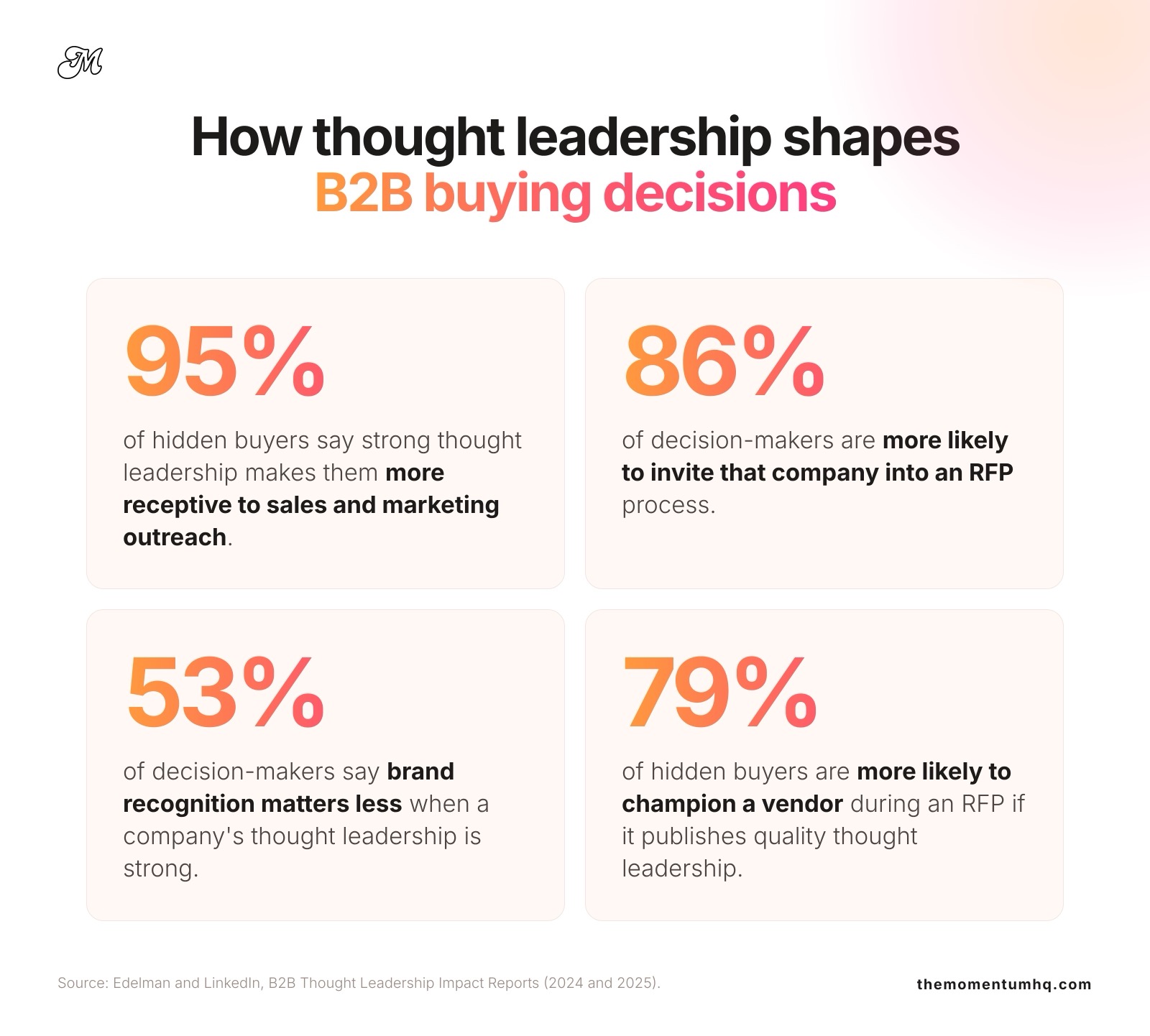
The distinction matters because the commercial effect comes from consistency, and Edelman and LinkedIn's B2B Thought Leadership Impact Report shows exactly what that consistency does to buyer behavior:
- 90% of decision-makers and C-suite executives say they'd be more receptive to sales or marketing outreach from a company that consistently produces high-quality thought leadership.
- 86% of decision-makers are more likely to invite organizations producing high-quality thought leadership into an RFP process.
- 53% of B2B decision-makers say brand recognition matters less when a company's thought leadership is strong.
- 79% of hidden buyers, the influencers who never appear on a vendor's contact list but shape what senior executives hear, are more likely to champion a vendor during an RFP if that vendor consistently publishes quality thought leadership.
What does thought leadership content look like?
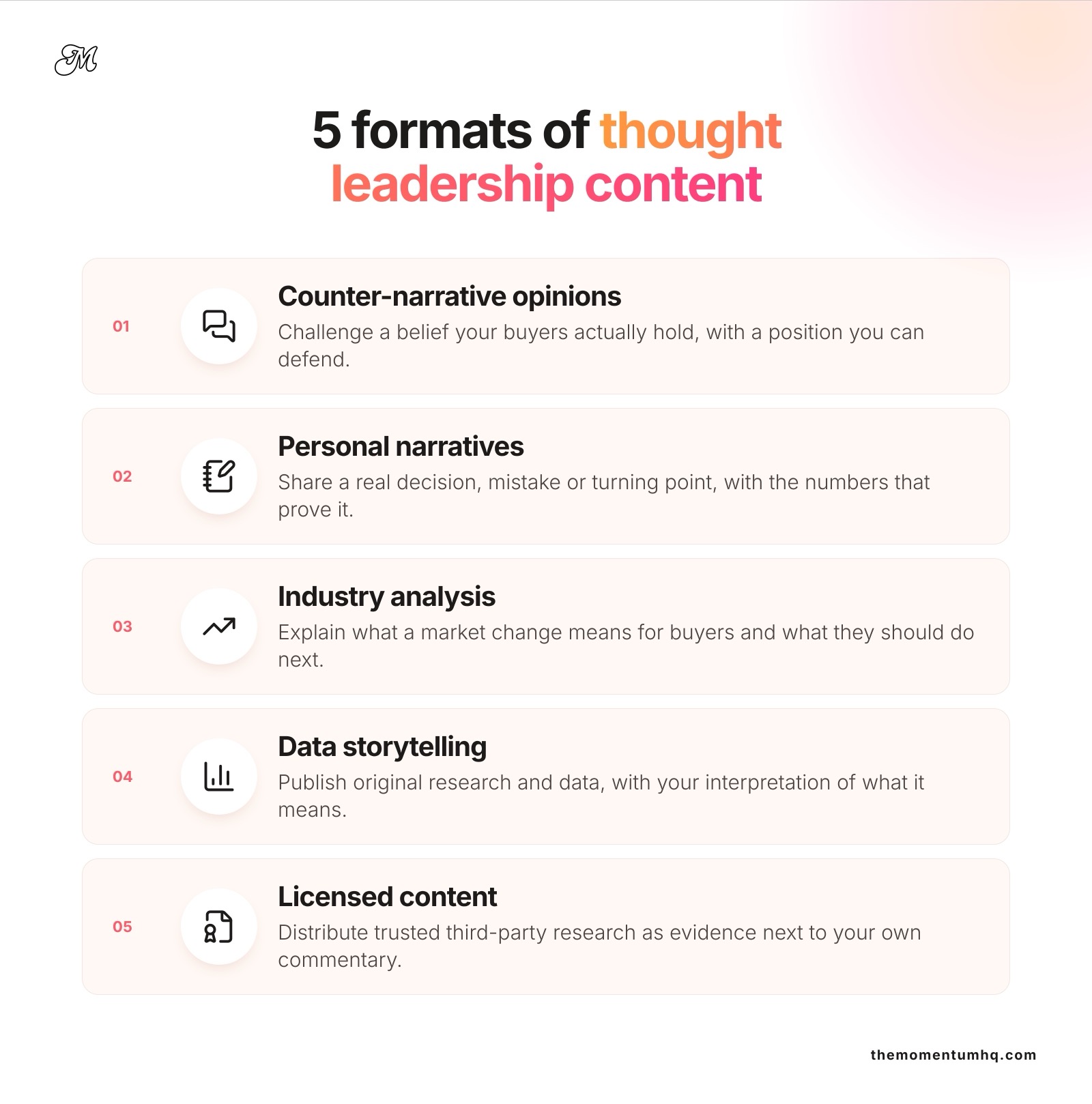
Thought leadership content appears in 5 main forms. Each does a different job, and most programs use two or three of them:
1. Counter-narrative opinions
A counter-narrative opinion challenges a belief your buyers currently hold and argues for a different position, supported by evidence or experience. It works because it gives the reader something to react to, which earns attention that a neutral summary does not.
For example, this statement would be considered a counter-narrative opinion: "Most B2B rebrands fail at the positioning stage, before design begins." The claim names a specific audience belief (rebrands are a design problem) and puts pressure on it.
Tip: Use this format only when the belief is one your buyers actually hold. A contrarian position against a belief nobody has reads as noise.
2. Personal narrative
A personal narrative is a first-person account of a decision, mistake, or turning point that taught the author something specific. It builds earned authority, which is the credibility that comes from having done the work, rather than the claimed authority that comes from a title.
A founder explaining why they replaced a 12-person content team with four senior people, and what changed in the output, gives buyers evidence of how that founder thinks. The specifics matter. A story without a real number, date, or consequence reads as a lesson written after the fact.
3. Industry analysis
Industry analysis interprets a change in the market and explains what it means for buyers. The change might be a regulation, a technology shift, or a pattern in buyer behavior. The value comes from the interpretation, since the news itself is already available everywhere.
A strong piece states what is changing, who is affected, what the author expects to happen next, and what a reader should do about it. Analysis that stops at summarizing the news does not qualify.
4. Data storytelling
Data storytelling presents original data, such as survey results, internal benchmarks, or anonymized customer data, along with an interpretation of what it means. It is the format buyers ask for most directly: 55% of decision-makers cited strong research and data as a top characteristic of quality thought leadership.
The Edelman-LinkedIn report is itself an example. It is research that a communications firm and a platform published, and it is cited across the industry every year. Original data creates that effect because other people link to it, quote it, and build arguments on it.
Publishing existing statistics with commentary is a weaker version of the same format. It can support a point of view, but it does not create a new asset.
5. Licensed content
Licensed content is third-party research that a company pays for the right to distribute to its own audience. Analyst firms sell this directly. Forrester's reprint program lets vendors use trusted third-party research reports in campaigns to strengthen their story, Gartner offers a library of over 4,000 content assets available for licensing, and IDC provides digital distribution rights to share its published research with a vendor's target audience.
The benefit is borrowed credibility and speed. The limit is differentiation: a competitor can license the same report. Licensed content works best as supporting evidence next to your own commentary.
How do you create thought leadership content?
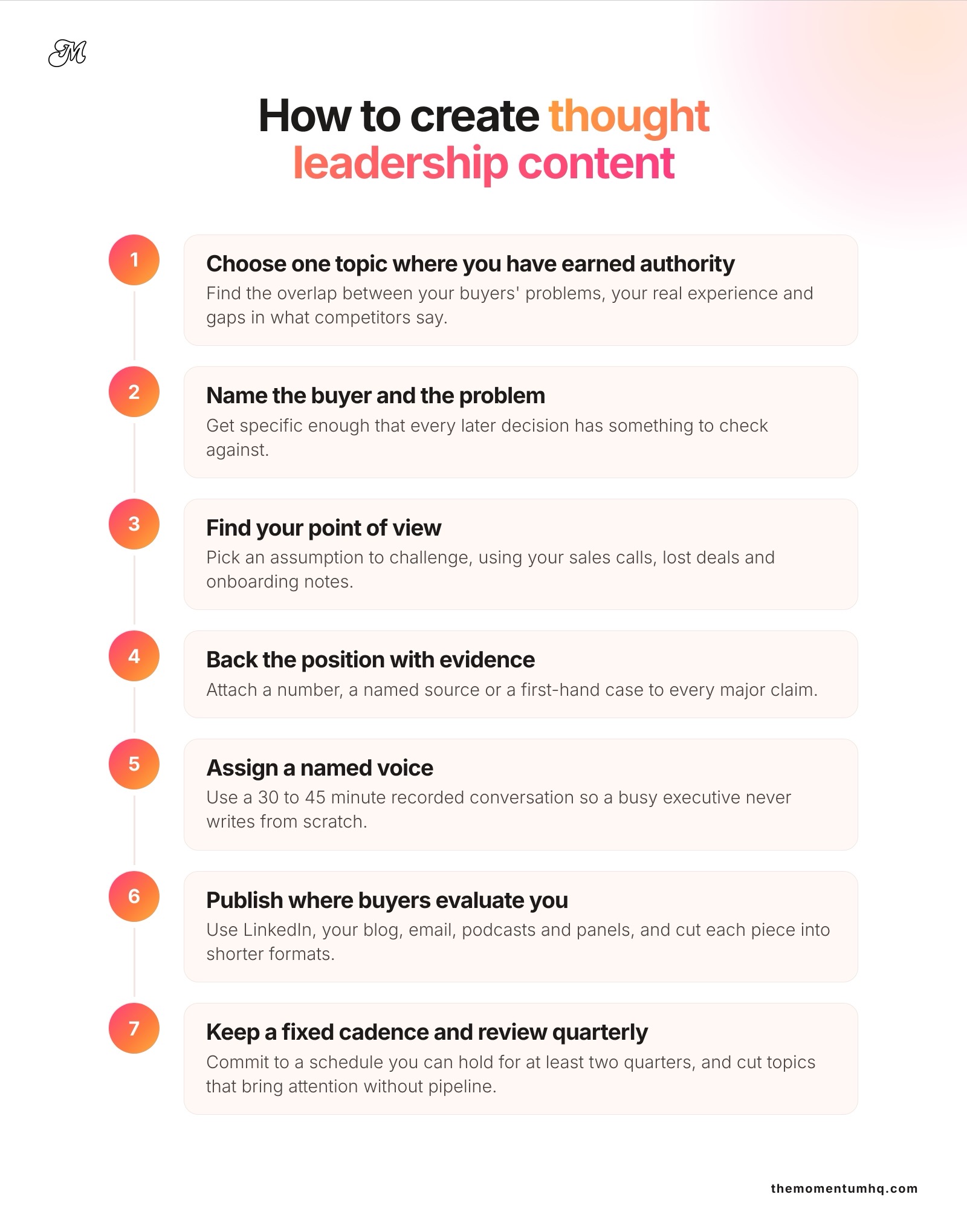
The process has 7 steps. Each one addresses a specific way thought leadership programs stall:
1. Choose one topic where you have earned authority
Pick the subject where your buyers' problem, your real experience, and a gap in what competitors say all overlap. A topic your team has no direct experience with will produce content that reads as researched rather than lived, and buyers can tell.
2. Name the buyer and the problem
Write down who the content is for and the specific problem it addresses. "Marketing leaders" is too broad. "Heads of marketing at scaling SaaS companies whose content output is high and pipeline contribution is unclear" gives every later decision something to check against.
3. Find the point of view
A point of view has an opponent: a common belief, habit, or assumption that you think is wrong. The best sources are internal. Review your sales calls, lost deals, customer onboarding notes, and the corrections your team makes to client assumptions. Patterns in those conversations are positions you already hold.
4. Back the position with evidence
Attach a number, a named source, or a first-hand case to every major claim. This step separates a position from an opinion. If you cannot support the claim, either narrow it to what you can support or collect the data before publishing.
5. Assign a named voice and a simple input process
Content attributed to a person carries more weight than content attributed to a company page. Choose the founder, executive, or subject-matter expert who will be the voice, then build a process that fits their schedule.
A 30-45-minute recorded conversation, followed by drafting and editing by a writer, gives a busy executive a way to contribute without writing anything from scratch.
6. Publish where buyers evaluate you
Publish in the places your buyers use to assess vendors. For most B2B companies, that means LinkedIn, the company blog, email, and podcasts or panels in the industry. Break each major piece into shorter formats so one idea reaches the audience several times.
7. Publish on a fixed cadence and review quarterly
Publish on a fixed cadence and review quarterly. 7 in 10 decision-makers say they're very likely to think more positively about organizations that consistently produce high-quality thought leadership. Set a cadence you can maintain for at least two quarters.
Does your business need a thought leadership strategy?
Not every business does. The question is whether your buyers evaluate expertise before they buy, and whether you have expertise worth showing them.
Signs you are ready
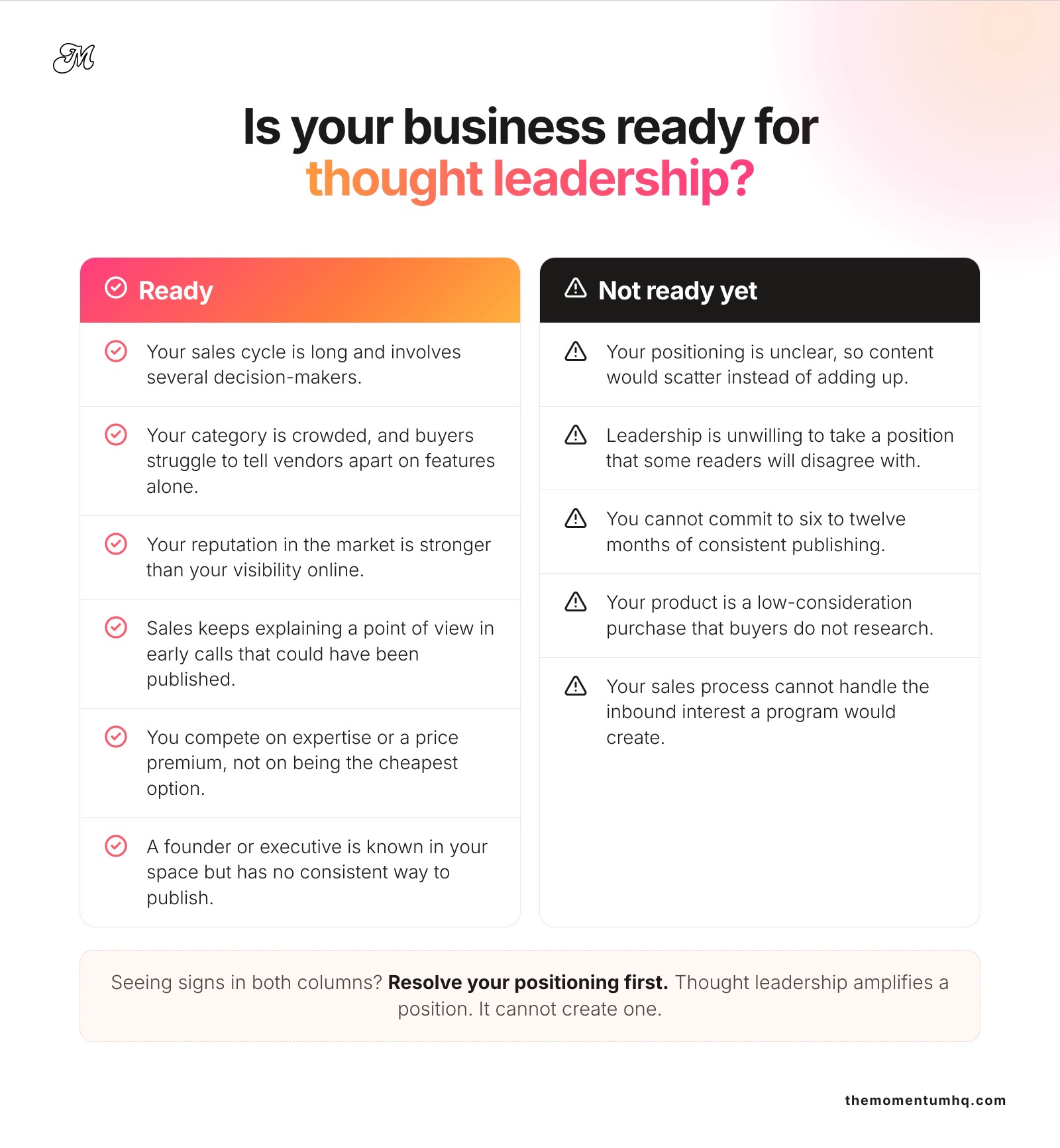
- Your sales cycle is long and involves several decision-makers, so buyers form views before your team speaks to them.
- Your category is crowded, and buyers struggle to tell vendors apart on features alone.
- Your reputation in the market is stronger than your visibility online.
- Sales spends time in early calls explaining a point of view that could have been published.
- You compete on expertise or price premium, not on being the lowest-cost option.
- A founder or executive is already known in the space and has no consistent way to publish.
Signs you are not ready
- Your positioning is unclear. Publishing content before you know what you stand for produces scattered content that a buyer cannot connect to a company.
- Leadership will not take a position. Thought leadership requires saying something that some readers will disagree with.
- You cannot commit to at least six to twelve months of consistent publishing.
- Your product is a low-consideration, transactional purchase where buyers do not research vendors.
- Your sales process cannot handle the inbound interest it would create.
If your answers point in both directions, start by resolving positioning. Thought leadership amplifies a position. It cannot create one.
How do you measure thought leadership content?
Measurement is where most programs fail. Many B2B companies have no process to measure the effectiveness of their thought leadership. A program that no one measures loses budget at the first review.
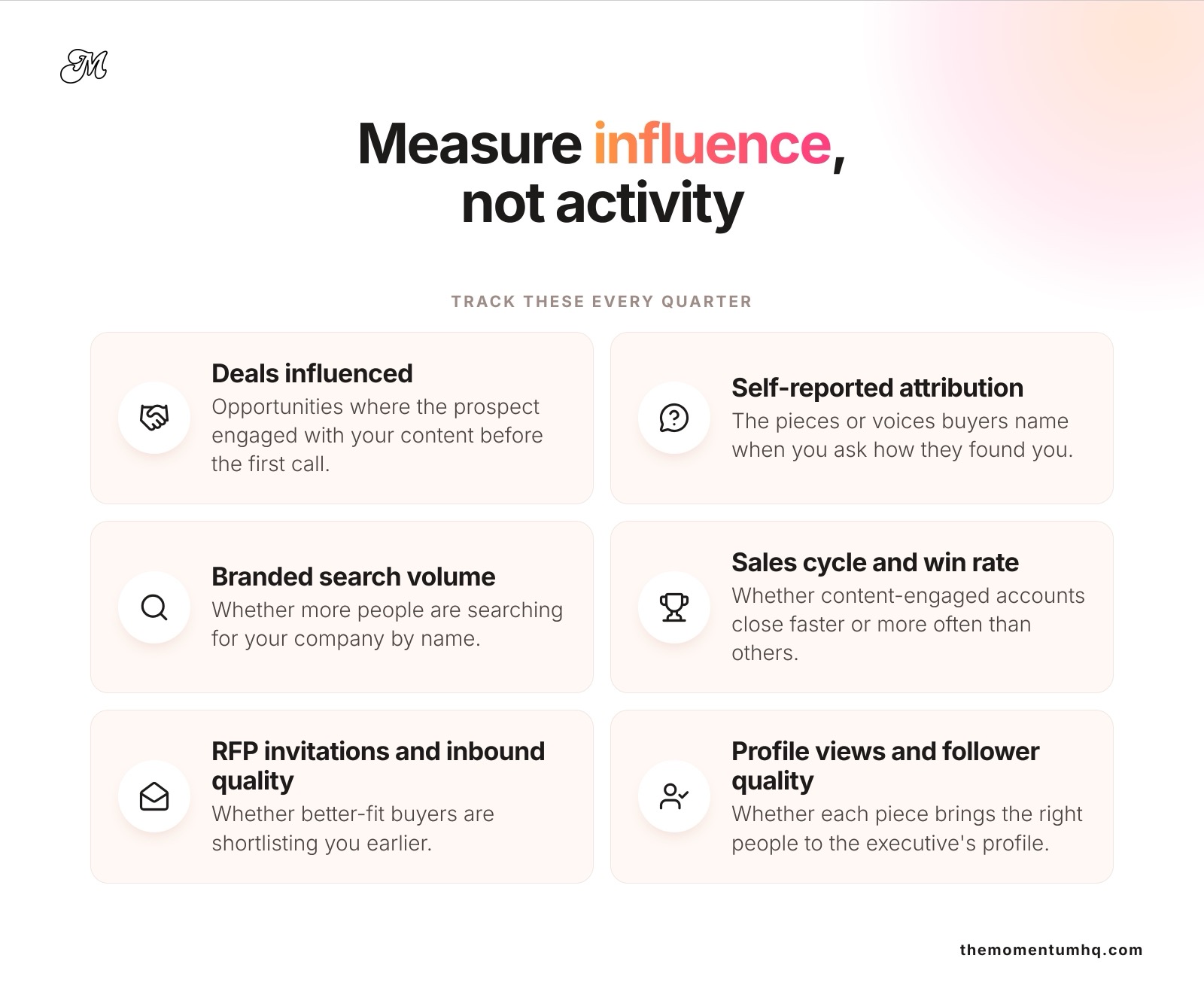
Here’s how you can track the metrics around thought leadership content:
| Measure | What it tells you |
|---|---|
| Deals influenced | How many opportunities involved a prospect who engaged with your content before the first call |
| Self-reported attribution | Which pieces or voices buyers name when asked how they found you |
| Branded search volume | Whether more people are looking for your company by name |
| Sales cycle length and win rate in engaged accounts | Whether content-engaged accounts move faster or close more often than others |
| RFP invitations and inbound quality | Whether you are being shortlisted earlier and by better-fit buyers |
| Profile views and follower quality per piece | Whether the content attracts the right people to the executive's profile |
Impressions, likes, and total follower counts describe activity. They do not describe influence on a purchase decision, so weigh them lightly. A post with 400 impressions that led to a request from a target account has done more than a post with 40,000 impressions and no buyer among the audience.
Review the scorecard every quarter, compare against the previous quarter, and cut topics that produce attention without a pipeline.
FAQs
What are the key trends in thought leadership for 2026?
Research-backed content is now the baseline expectation. Hidden buyers outside the formal buying group have become a real audience. Executive voices now carry more weight than company pages, since LinkedIn's ranking favors personal profiles. And content that's specific and quotable is more likely to be cited in AI-generated answers.
Who are some famous thought leaders?
Peter Drucker shaped modern management thinking, Clayton Christensen introduced disruptive innovation theory, and Jim Collins built Good to Great on years of research. Simon Sinek, Adam Grant, and Scott Galloway each hold a clear, evidence-backed position and have published on it consistently for years.
What makes a good thought leader?
A good thought leader has a specific area of expertise, holds a position others can disagree with, supports it with evidence, and publishes consistently enough for an audience to form a view. The title follows from that record; calling yourself one doesn't produce it.
What is the concept of thought leadership?
Thought leadership is the practice of earning influence in a field by sharing original, well-supported thinking. The term is generally credited to Joel Kurtzman, who coined it in Strategy+Business in the 1990s. Today it refers to content that builds trust with a specific audience before a purchase decision.
What is an example of thought leadership?
The Edelman-LinkedIn B2B Thought Leadership Impact Report is a clear example: original, annual research that's widely quoted and positions both publishers as authorities on B2B buying. At a smaller scale, a founder publishing a first-person account of a pricing change, with real numbers, also qualifies.
Why is thought leadership important?
It changes how buyers evaluate you before a conversation starts. More than 75% of decision-makers say a piece of thought leadership led them to research a vendor they weren't previously considering. It also affects who gets invited to an RFP and which vendor gets championed internally.
Final thoughts
Thought leadership content works when it starts with a position the company is willing to defend, and when someone tracks whether it's producing business outcomes. The position has to come from your own experience; the formats and steps above only give it structure.
Many founders and marketing leaders have the expertise and lack the time to turn it into a consistent program. If your business has expertise buyers should see and no system to publish it, Momentum's executive thought leadership service builds that voice and program for you. Get in touch today.