Buyers now form an opinion about your brand before a human at your company ever speaks to them, and the system that forms that opinion has changed in the last year. Now that we’re stepping into a new quarter, it’s important for B2B brands to know exactly what you can do to attract, retain, and satisfy your clients.
This article covers the 8 B2B branding trends worth tracking in 2027. It also explains why branding is changing faster than usual right now, and gives you an easier way to decide which trends deserve a chunk of your budget first.
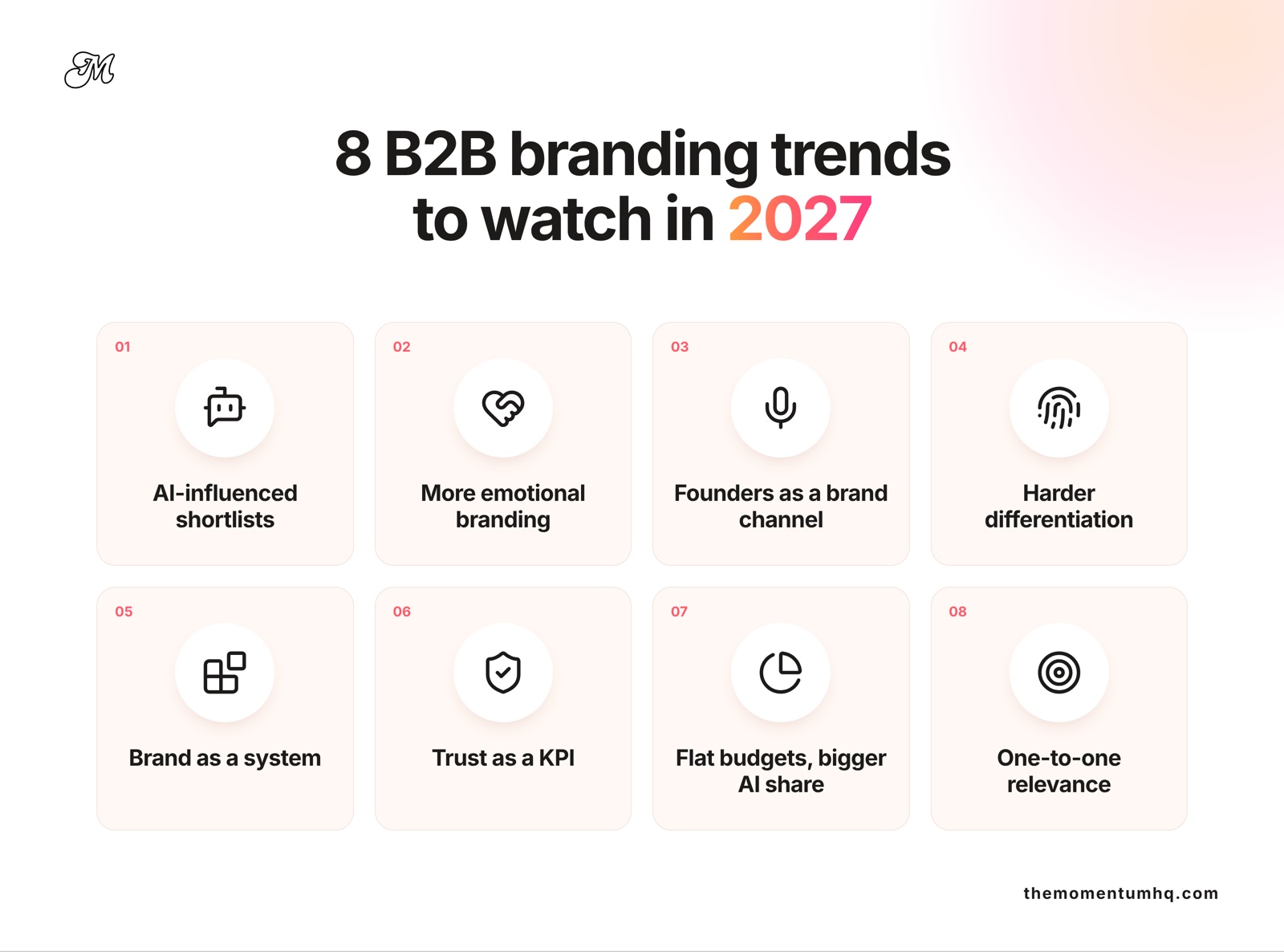
The 8 B2B branding trends to watch in 2027
Eight shifts are changing how B2B companies get found, trusted, and chosen in 2027. Keep reading to learn how you can keep up.
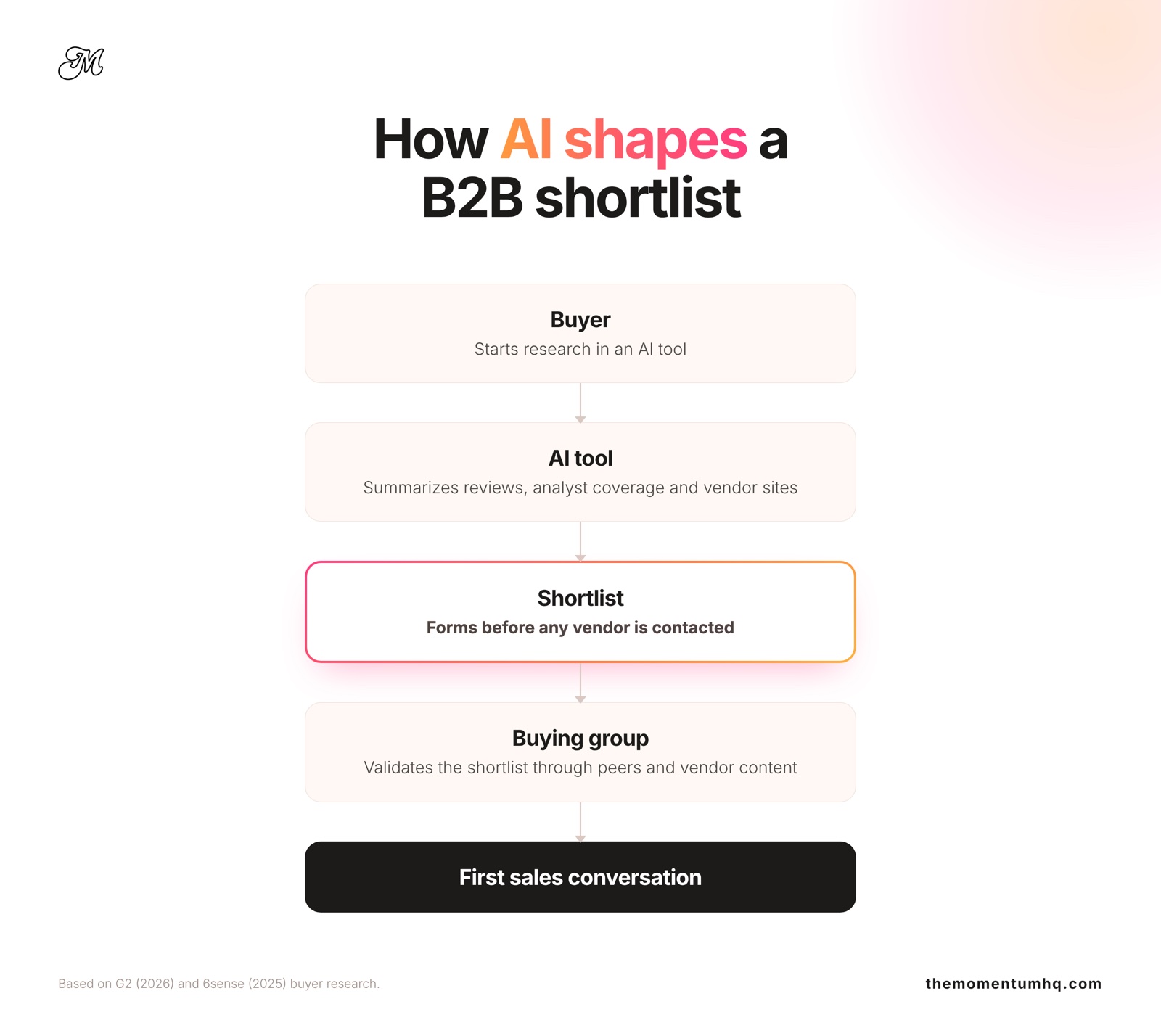
1. AI is influencing your shortlist before a buyer sees your site
AI tools synthesize vendor information, buyer reviews, and third-party data long before a prospect reaches out to a sales representative. 51% of B2B buyers start their research with an AI chatbot, more often than with traditional search engines, up from 29% the previous year.
Forrester's business-buying research confirms that generative AI search has become a primary starting point for B2B discovery.
However, AI does not make purchasing decisions on its own. 94% of buyers use large language models primarily to compare and synthesize vendor information, using AI to refine shortlists while still relying on human interactions to validate final choices.
Tip: Your positioning now needs to be clear enough that an AI tool can summarize it accurately, and consistent enough across your site, press coverage, and reviews that the summary doesn't vary depending on where it was pulled from.
2. B2B branding is getting more emotional
B2B buying decisions are driven by personal risk reduction and organizational confidence rather than feature lists alone. We’re also seeing that buyers are nearly three times more likely to show high brand commitment when they perceive personal benefits from a supplier rather than solely functional features.
While emotional connection drives long-term brand equity, rational messaging remains critical for short-term conversion at the decision stage. LinkedIn's analysis of IPA research notes that rational messaging generates strong activation effects, but emotional positioning builds the overarching brand trust required to close complex enterprise deals.
3. Founders and executives are becoming a major brand channel
Executive personal brands generate higher organic engagement and trust than corporate media channels. Today, executive thought leadership directly influences buying groups regardless of your industry or offer, helping lesser-known brands establish immediate credibility and advocacy.
67% of decision-makers prefer thought leadership featuring an identifiable author rather than a faceless corporate entity, with 49% of buyers actively researching sales professionals and founders on LinkedIn before engaging. Empowering leadership to publish original frameworks transforms executive profiles into a core pipeline generation channel.
Tip: If your founder or executive team has no consistent presence, you're leaving a distribution advantage on the table that your competitors' leadership may already be using.
4. AI-generated content is making B2B brands harder to differentiate
The rapid adoption of generative AI tools has saturated the market with generic, lookalike marketing content. LinkedIn's B2B benchmark warns of a growing problem of sameness resulting from synthetic copy and automated production when speed is prioritized over strategy.
Widespread AI usage lowers the barrier to content production, flooding channels with interchangeable messaging and causing brand drift. To stand out against synthetic noise, B2B brands must anchor their positioning in:
- Proprietary survey data
- Original research,
- Customer case studies that large language models cannot replicate
In short, brands need to build their foundational positioning before AI gets involved.
5. Branding is becoming a system, not a one-time project
A brand is no longer a static visual identity delivered in a PDF binder; it is a dynamic operational system. Across various industries, we can prove that maintaining consistent brand experiences across content, sales enablement, and customer service touchpoints is more important than before. The good news is that you can do it through continuous AI-enabled governance.
Similarly, AI is fundamentally reshaping how brand and communications teams structure their operations. Modern B2B branding requires the following across all customer touchpoints:
- Flexible component libraries
- Continuous visual iteration
- Unified tone-of-voice frameworks
Tip: Treat your brand guidelines as a living reference your team and any outside partners check against regularly, instead of a PDF produced once during a rebrand.
6. Trust is becoming a KPI for B2B brands
As AI content multiplies, trust has shifted from an abstract concept into a critical commercial metric. Gartner's research points out an industry evolution from attention scarcity to trust scarcity, making credibility signals the primary driver of brand preference and pipeline velocity.
Despite this strategic focus, Forrester notes that many B2B organizations still struggle with formal brand measurement frameworks. Elevating trust to an organizational KPI requires tracking buyer sentiment on:
- Independent review platforms
- Public compliance credentials
- Customer retention metrics
- Traditional attribution models
Trust is becoming something you can track through citations, reviews, and how often your content gets referenced elsewhere.
7. Marketing budgets are flat while AI takes a bigger share
Overall B2B marketing budgets remain constrained across industries, requiring leaders to reallocate existing capital toward technology and automation.
A CMO Spend Survey reveals that marketing budgets averaged 7.8% of total revenue, while CMOs allocated an average of 15.3% of their total budgets specifically to AI initiatives.
This means that branding work is now competing for budget against AI tooling inside a budget that isn't expanding. Every dollar spent on a brand needs to justify itself more clearly than it did two years ago.
Because overall marketing budgets are not expanding, investment in AI tools requires shifting capital away from low-performing channels. Reallocating resources toward automation frees up capital to fund high-impact brand initiatives like original research reports, executive media production, and high-touch customer experiences.
8. B2B brands are moving toward one-to-one relevance
Generic account-based marketing tactics are giving way to hyper-personalized account experiences tailored to specific buying committees. Market leaders are up to four times more likely to execute true one-to-one personalization than their industry peers.
Rather than relying on broad personas, leading B2B brands tailor messaging, landing pages, and campaign collateral to specific corporate environments and technical architectures. Delivering precise relevance across entire buying groups increases deal velocity and enterprise conversion rates.
| Trend | Operational Shift | Key Deliverable |
|---|---|---|
| AI Shortlists | Move from manual SEO to answer engine optimization | Structured schema and consistent third-party citations |
| Emotional Branding | Shift from purely functional messaging to personal risk mitigation | Messaging frameworks highlighting security and support |
| Executive Branding | Transition from corporate accounts to founder and executive media | Weekly leadership commentary and expert opinion pieces |
| AI Differentiation | Move away from generic synthetic copy toward original perspective | Proprietary research reports and original survey data |
| Modular Systems | Replace one-time PDF brand books with dynamic operational systems | Component design libraries and brand governance tools |
| Trust as a KPI | Shift focus from vanity awareness metrics to credibility signals | Verified review profiles and public compliance records |
| Budget Realignment | Shift low-performing campaign spend into AI tools and high-impact assets | Automated distribution workflows and custom research |
| One-to-One Relevance | Move from broad buyer personas to hyper-personalized account assets | Custom landing pages and bespoke sales collateral |
Why B2B branding is changing faster than it used to
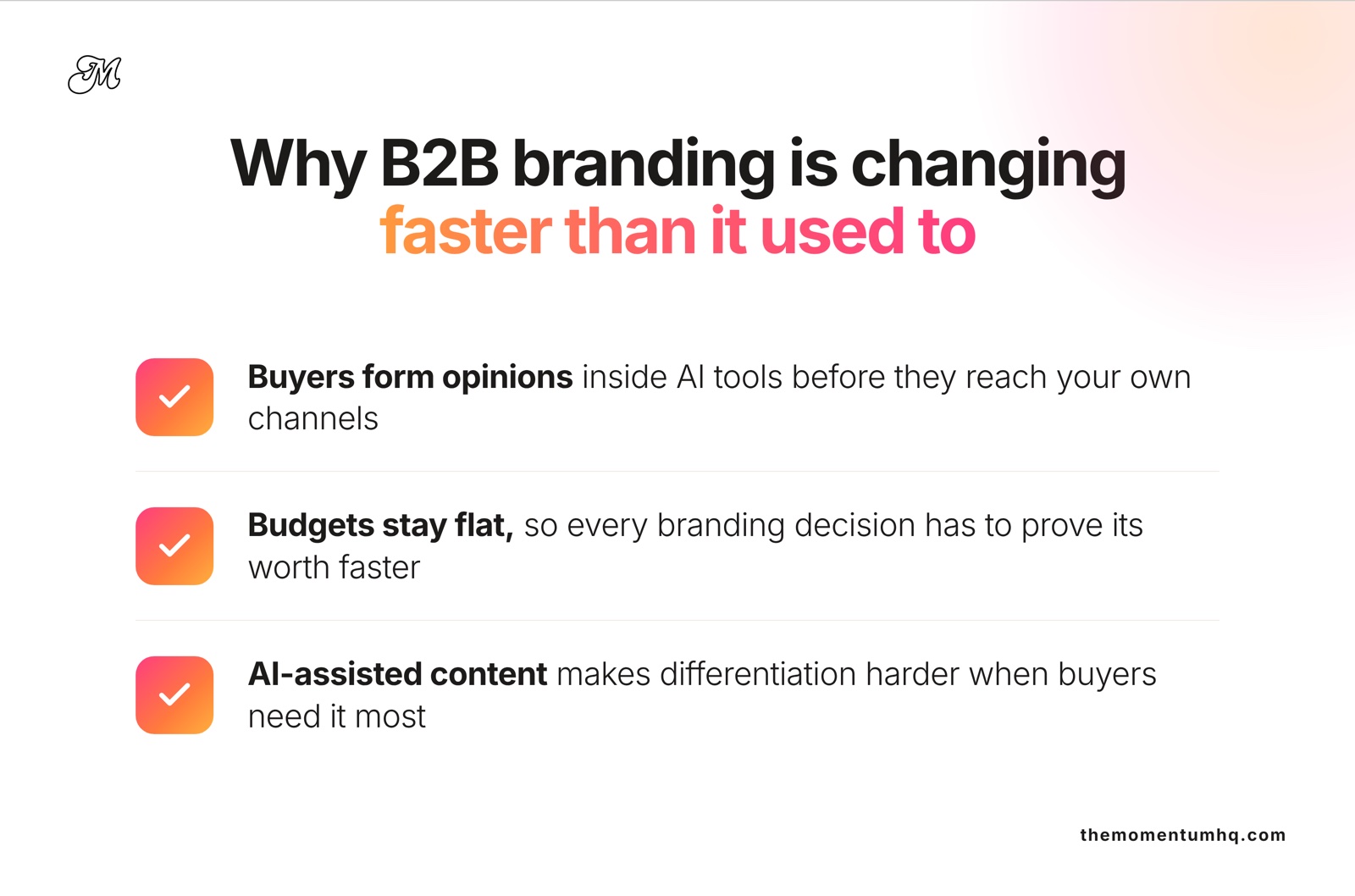
B2B branding is changing faster because the systems buyers use to evaluate vendors, AI search tools, LinkedIn's ranking algorithm, and analyst scrutiny have all shifted within the same 12-to-18-month window.
In previous years, a brand refresh every three to five years was enough to stay current. That timeline no longer matches how quickly the underlying discovery and trust mechanisms are moving.
Three forces are compounding at once:
- Buyers are forming opinions inside AI tools before they reach a company's own channels
- Budgets are flat so every branding decision has to prove its worth faster
- AI-assisted content production is making differentiation harder when buyers need it most
A brand strategy built for 2023's environment is now operating inside a different set of rules.
How to prioritize these trends for your business
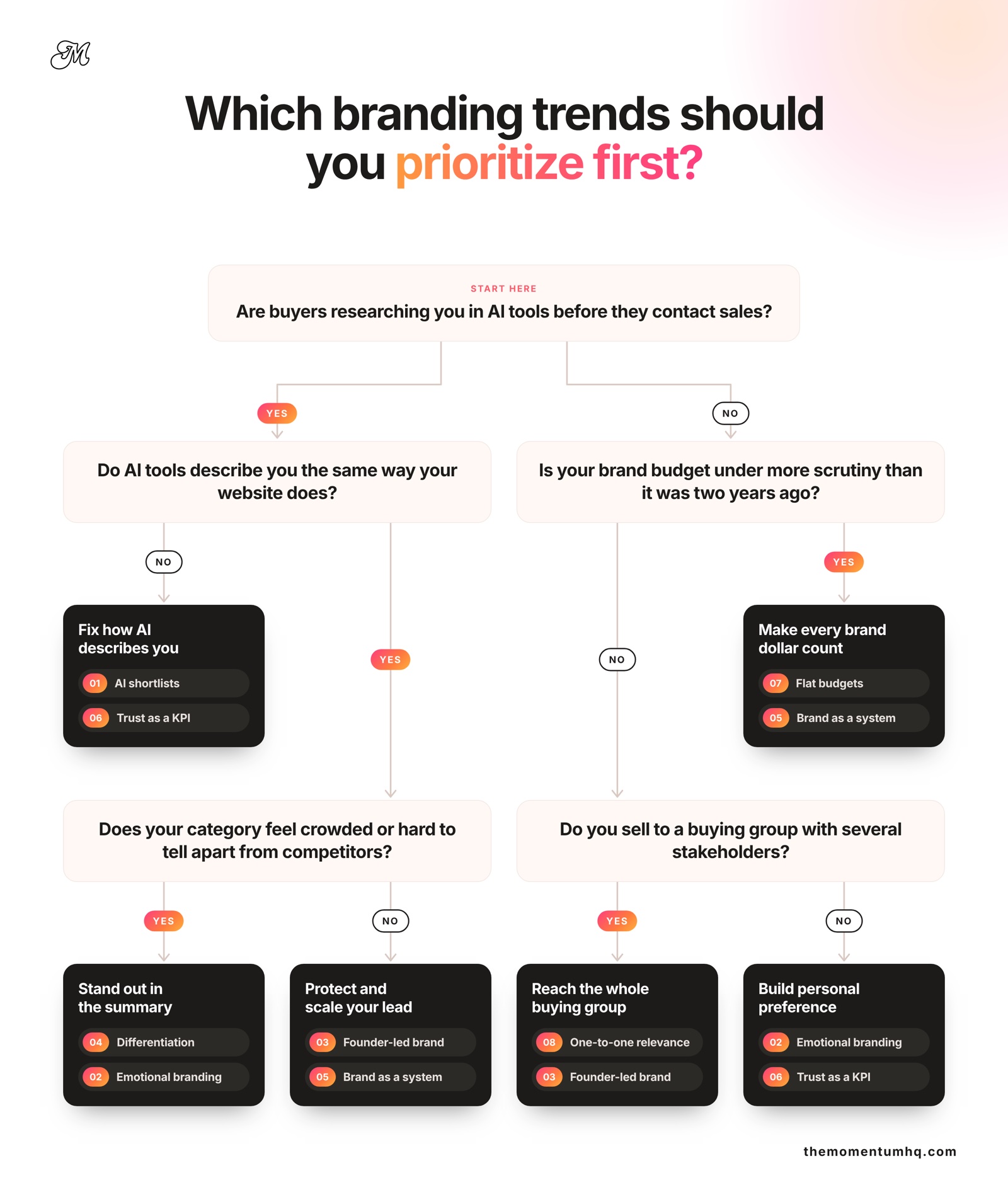
Prioritize the trends that affect how buyers currently find and evaluate you, not the ones that sound the most interesting. Start with these three questions:
| Question | If yes, prioritize |
|---|---|
| Are buyers researching you in AI tools before contacting sales? | Trend 1 (AI shortlists) and Trend 6 (trust as a KPI) |
| Does your category feel crowded or hard to tell apart from competitors? | Trend 2 (emotional positioning) and Trend 4 (differentiation) |
| Is your brand budget under more scrutiny than it was two years ago? | Trend 7 (flat budgets) and Trend 5 (brand as a system) |
A trend is worth acting on now if it affects a channel your buyers already use. It can wait if it describes a shift that hasn't reached your specific market yet; for example, one-to-one personalization (Trend 8) matters far more for a company with a multi-stakeholder enterprise sales process than one selling a low-consideration, single-buyer product.
FAQs
What are the biggest B2B branding trends for 2027?
The biggest trends are AI shaping vendor shortlists before buyers reach a company's site, emotional positioning outperforming rational messaging, founders becoming a primary brand channel, and flat budgets competing against rising AI spend. All four are backed by named research cited above.
Is B2B branding different from B2C branding?
Yes, meaningfully. B2B branding has to persuade a buying committee of several people over a long sales cycle, while B2C branding typically targets one individual making a faster decision. Both increasingly rely on emotional connection, but B2B branding also has to hold up under technical scrutiny.
How often should a B2B company rebrand?
There's no fixed interval, since a rebrand should follow a real trigger, such as outgrowing your original positioning, entering a new market, or a merger, not a calendar date. Most companies reassess brand fit annually and consider a full rebrand only every several years.
What's the difference between brand and marketing?
Brand is how your company is perceived and remembered; marketing is the set of activities used to build and distribute that perception. Brand answers "why should someone choose us," while marketing covers the channels, campaigns, and content used to get that answer in front of buyers.
Do small B2B companies need to worry about branding trends?
Yes, though not every trend applies equally. A small company competing in a crowded category needs differentiation and emotional positioning as much as a large one does. Trends tied to enterprise-scale budgets or multi-stakeholder personalization matter less until the company reaches that stage.
How much should a B2B company budget for branding?
Branding typically sits inside the broader marketing budget rather than as a separate line item. Gartner's 2026 CMO Spend Survey found overall marketing budgets average 7.8% of company revenue, with early-stage B2B companies often budgeting higher to build initial brand awareness.
Final Thoughts
B2B branding is changing because the systems buyers use to evaluate vendors changed first. The companies that stay ahead in 2027 won't be the ones chasing every trend on this list. They'll be the ones that know which two or three actually affect how their specific buyers discover and trust them, and that invest there deliberately.
If you're not sure which trends matter for your business, Momentum's marketing strategy work starts by answering exactly that question, then builds a plan with clear priorities around it. Reach out today.